Today's
EarthStation1.com 15% Off Commemorative Memorial Title: Jerry Lee
Lewis: I Am What I Am DVD, Video Download, USB Flash Drive
Today, April 16, 2026
April 16: National Cash Day: -- An annual
celebration of the name Cash, a surname found in the U.S., the
U.K., and many other English-speaking countries. Although stars
like Johnny Cash helped make the name world-famous, it has been
around for several centuries. In countries like Ireland, Cash can
also be a girl's name, which is often a shortened 'Cassandra,'
also known as 'Cass,' Greek for 'shining upon men.' The French
word 'Caisse,' meaning box or chest, also translates to 'Cash,'
which means 'maker of chests,' which comes from the European
tradition of naming people after the profession of their
ancestors. Cash is the diminutive form of 'Cassius,' a Latin boy's
name meaning 'hollow.' Gaius Cassius Longinus, a Roman general and
senator who was among the leaders of the plot to assassinate
Julius Caesar, is one of the best-known individuals to carry this
name. Cassius is also featured as the main character in William
Shakespeare's "The Tragedy of Julius Caesar." Cassius
Clay, better known as Mohamed Ali, is perhaps the most notable
figure to bear this name in recent times. A vocal abolitionist and
supporter of the civil rights movement, the boxing champion would
have left his mark on the world even if he had not changed his
name. To this day, he is still considered the greatest sportsman
of all time and one of the most entertaining celebrities of his
era. Cash is also an Anglo-Scottish surname for boys. Johnny Cash,
the celebrated singer-songwriter, is undoubtedly the most famous
individual to carry this name. Born in 1932, Cash was known for
his deep bass-baritone voice, distinctive instrumentals, and
hard-hitting lyrics that focused on themes of sadness, pain,
depression, and redemption. Cash was one of the most influential
celebrities of his time, attracting audiences young and old with
his charming persona and average Joe appeal. His troubled life
rocked by substance abuse, addiction, repeated adultery, and being
an absentee parent came to epitomize the rock and roll culture
that began emerging in the 1950s and 1960s America. On Sale @ 15%
Off Discount Till Midnight PT!
https://store.earthstation1.com/jerry-lee-lewis-i-am-what-i-am-19871987.html
Today's
EarthStation1.com 15% Off Commemorative Memorial Title: Fibber
McGee And Molly Complete Radio Series MP3 DVD, Download, USB
Today, April 16, 2026
April 16: The Day Of The Mushroom: --
Today we honor all things fungi! The fleshy, spore-bearing
fruiting body of a fungus, which can grow anywhere above ground,
on soil, or its food source, is known as a mushroom. The white
button mushroom, which is grown, is the standard fungus to be
called a mushroom. Therefore, fungi with a stem, cap, and gills on
the underside of their cap are those to which the term "mushroom"
is most frequently applied. The name "mushroom" is also
relevant to describing the fleshy fruiting bodies of other
Ascomycota because it is used to describe a range of different
gilled fungi that may or may not have a stem. Since they first
appeared in early European communities, it is generally assumed
that people have been gathering mushrooms since the beginning of
time, possibly even in prehistoric times. Truffles and other types
of mushrooms were prized in classical Greece and Rome. American
author Cynthia Bertelsen claims in her book "Mushroom: A
Global History" that both well-known historical authors,
Pliny the Elder and Aristotle, wrote about fungus. She also claims
that the Roman philosopher Galen wrote several paragraphs on the
collection of wild mushrooms. Cynthia Bertelsen goes on to add
that it is likely that China and Japan were the first places to
cultivate mushrooms as early as 600 A.D. But it took time for
Americans to accept and become accustomed to mushrooms. In the
cookbook "The Virginia Housewife," mushrooms are
mentioned for the first time in America (1824). Campbell's Cream
of Mushroom Soup, a classic American staple for casserole recipes,
was created in the 1930s. Bertelsen adds that there may be
archaeological proof of the spiritual usage of mushrooms as early
as 10000 B.C. There is proof that various cultures, including the
Ancient Greeks, the Mayans, the Chinese, and the Vikings, among
many others, used hallucinogenic mushrooms. Humans now consume
edible mushrooms regularly, which has greatly boosted the
agricultural and agro-economic development of the areas where they
are grown. Around half of all farmed edible mushrooms are produced
in China, which also accounts for six pounds of yearly mushroom
consumption per person among the world's 1.4 billion inhabitants.
With an estimated 194,000 tonnes of yearly edible mushroom
exports, Poland was the leading exporter of mushrooms in 2014. On
Sale @ 15% Off Discount Till Midnight PT!
https://store.earthstation1.com/fibber-mcgee-and-molly-mp3-dvd-complete-radio-serie3.html
Today's
EarthStation1.com 15% Off Commemorative Memorial Title: Hannibal:
The Terror Of Rome Documentary Series MP4 Video Download DVD
Today, April 16, 2026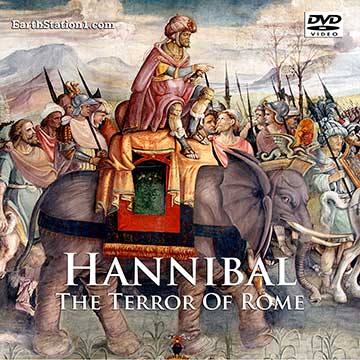
April 16: Save The Elephant Day: --
Observed across the world every year, the purpose of Save The
Elephant Day is to raise awareness about the predicament of
elephants, whose population has continued to decline quite
noticeably. Elephants are the largest existing land animals and
are spread across Africa and Asia. Recent studies estimate that
there are now just over 400,000 elephants across the African
continent and although the situation differs from country to
country, it can not be denied that the giant mammals are in
decline on a continent-wide scale. Human activities such as
poaching for ivory remain a significant reason for the decline.
Save the Elephant Day seeks to change this upsetting trend by
educating people about elephants and the predicament they face,
encouraging everyone to do their bit in helping to save elephants
from extinction. Organizations across the world have worked
together to tackle some of the major threats elephant populations
face. In 1989, the international commercial trade of ivory was
banned. The Convention on International Trade in Endangered
Species (CITES) secured an agreement among its member states to
ban the international ivory trade. In 2016, China, which is the
world's largest ivory market, called for the ban of all ivory
sales within the country. On December 20, 2018, the U.K. Ivory Act
2018 received royal assent after being passed by the British
Parliament. The act may be extended to include hippos, walruses,
and narwhals in the future. In 2012, Save the Elephant Day was
established by the Elephant Reintroduction Foundation in Thailand,
together with Patricia Sims, a Canadian filmmaker. The launch of
this worldwide initiative in the year 2012 saw the release of the
"Return to the Forest," a documentary film narrated by
"Star Trek" actor William Shatner. On Sale @ 15% Off
Discount Till Midnight PT!
https://store.earthstation1.com/hannibal-the-terror-of-rome-documentary-series-mp4-video-download-dv4.html
Today's
EarthStation1.com 15% Off Commemorative Memorial Title: Bob
Newhart: Off The Record TV Special DVD, MP4 Download, USB Drive
Today, April 16, 2026
April 16: National Librarian Day: -- A
chance to be thankful for all the knowledge that librarians
possess. You may think of them as book-slingers who spend all day
cataloging and reshelving, but librarians play a much more
important role. From children's storytime to literacy classes,
libraries offer a wealth of free public resources. Trained in
Library Science, professional librarians work with complex
cataloging systems to organize books, make purchasing decisions
for their library, liaise with local schools and universities,
organize events and programming, teach classes, and more. Their
role is constantly evolving to adapt to new technology and social
needs. Celebrate National Librarian Day with us and say thanks to
the awesome librarians that are always on hand to help.
Stereotyped in pop culture as bespectacled older ladies who
constantly shush their teen patrons, librarians are dedicated
professionals who perform a variety of tasks to keep libraries
running, organize programming, and update their collections. The
first large libraries in the U.S. were mostly privately owned and
required entry fees or paid memberships to gain access. The
concept of free public libraries took hold by the late 1800s. In
the early 20th century, after Melvil Dewey standardized library
cataloging with his Dewey Decimal System and other practices,
public libraries rapidly expanded with thousands of new branches
across the country. By 1900, the scope of libraries also expanded,
with many offering reference departments and interlibrary loans.
During the Great Depression, libraries served as a lifeline for
struggling families seeking a cozy refuge and free entertainment.
Today, libraries function as so much more than repositories of
knowledge. To keep up with changing technology, library offerings
now include audiobooks, e-reader materials, free computer skills
classes, and access to free online resources. Many public
libraries offer language and citizenship classes, access to useful
tools, technology like 3D printers and computers, and free
workshops on a variety of hobbies and life skills. They provide a
quiet shelter during hot or rainy days at no cost, and they serve
as a safe, welcoming hangout for children and teens. On Sale @ 15%
Off Discount Till Midnight PT!
https://store.earthstation1.com/bob-newhart-off-the-record-dvd-mp4-us4.html
Today's
EarthStation1.com 15% Off Commemorative Memorial Title: Romer's
Egypt Ancient Egypt TV Series/The Hyksos Invasion MP4 DVD Set
Today, April 16, 2026
April 16, 1457 BC: Ancient Egypt: New
Kingdom: Eighteenth Dynasty: The Military Campaigns Of Thutmose
III: Thutmose III's First Campaign (Thutmose III's First Campaign
In The Levant): The Battle Of Megiddo (The Battle Of Megido, The
Battle Of Megiddo (15th Century BC), The Battle Of Armageddon): --
The likely date of the first battle in history to have been
recorded in what is accepted as relatively reliable detail, which
occured between the Egyptian Pharaoh Thutmose III and a large
coalition of Canaanite states let by the King Of Kadesh ("Holy").
Megiddo is also the first recorded use of the composite bow and
the first body count. All details of the battle come from Egyptian
sources, primarily the hieroglyphic writings on the Hall of Annals
in the Temple of Amun-Re at Karnak, Thebes (now Luxor), by the
military scribe Tjaneni. One unanticipated result of the battle
came in the form of the word Armageddon, which took its root from
Megiddo's name, meaning "the high place of Megiddo" (Ha
Megiddo), a site with a practically unrestricted view in any
direction from horizon to horizon, signifying among other things
that an approaching enemy army could be seen from there from as
far away as it would be possible to see: meaning they could be
seen coming from a long way off for a long time. The Battle Of
Megiddo was an Egyptian victory and resulted in a rout of the
Canaanite forces, which fled to safety in the city of Megiddo.
Their action resulted in the subsequent lengthy Siege of Megiddo.
The city was besieged for seven months and the King of Kadesh
escaped. Thutmose built a moat and a wooden palisade, eventually
forcing its occupants to surrender. At Karnak it is recorded that
the victorious army took home 340 prisoners, 2,041 mares, 191
foals, 6 stallions, 924 chariots, 200 suits of armor, 502 bows,
1,929 cattle, 22,500 sheep, and the royal armor, chariot and
tent-poles of the King of Megiddo. The city and citizens were
spared. A number of other cities in the Jezreel Valley were
conquered and Egyptian authority in the area was restored. By
reestablishing Egyptian dominance in the Levant, Thutmose III
began a reign in which the Egyptian Empire reached its greatest
expanse. On Sale @ 15% Off Discount Till Midnight PT!
https://store.earthstation1.com/romer39s-egypt-dvd-set-complete-tv-series-2-di392.html
Today's
EarthStation1.com 15% Off Commemorative Memorial Title: The Roman
Legions Documentary Set MP4 Video Download DVD
Today, April 16, 2026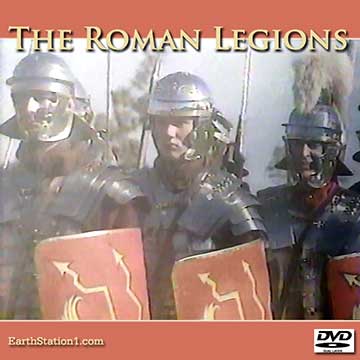
April 16, AD 73: The History Of Judaism:
The History Of Israel: Judaea: The History Of Judaea: The
Jewish-Roman Wars: The First Jewish-Roman War (The Great Jewish
Revolt (Hebrew: Ha-Mered Ha-Gadol), The Jewish War): The Siege Of
Masada: -- Masada, an extraordinarily formidable Jewish fortress
on top of an isolated rock plateau located on the eastern edge of
the Judaean Desert, overlooking the Dead Sea 20 km (12 mi) east of
Tel Arad (Southern District of Israel) falls to the Romans after
several months of siege, ending the Great Jewish Revolt. Judean
King Herod the Great had built two palaces for himself on the
mountain, and fortified Masada between 37 and 31 BCE. According to
Josephus, the siege of Masada ended in the mass suicide of the 960
Sicarii rebels who were hiding there; however, the archaeological
evidence relevant to a mass suicide event is considered by some to
be ambiguous at best, and is rejected entirely by some scholars.
The siege ramp built by the Romans to take Masada is considered to
be one of the greatest achievements of military engineering.
Today, Masada is one of Israel's most popular tourist attractions;
during 2005 to 2007, and 2009 to 2012, it was the second-most
popular, behind the Jerusalem Biblical Zoo. The site attracts
around 750,000 visitors a year. On Sale @ 15% Off Discount Till
Midnight PT!
https://store.earthstation1.com/the-roman-legions-documentary-set-mp4-video-download-dv4.html
Today's
EarthStation1.com 15% Off Commemorative Memorial Title: Marcel
Proust: A Writer's Life Biography + Bonus Title DVD, MP4, USB
Today, April 16, 2026
April 16, 1844: #BOTD: #HBD! Anatole
France, French poet, journalist, and novelist with several
best-sellers, Nobel Prize laureate (d. October 12, 1924) is #born
Francois-Anatole Thibault in Paris, France. Ironic and skeptical,
he was considered in his day the ideal French man of letters. He
was a member of the Academie Francaise (the French Academy), the
principal French council for matters pertaining to the French
language. France took a part in the Dreyfus Affair, a political
scandal that divided the Third French Republic for 12 years in
which the Jewish Captain Alfred Dreyfus was wrongfully convicted
of treason, a historic example of a miscarriage of justice and
antisemitism, a scandal in which the role played by the members of
the press such as Anatole France and Emile Zola proved influential
in resolving the conflict in Captain Dreyfus' favor. France wrote
about the affair in his 1901 novel Monsieur Bergeret. In 1921
France was awarded the Nobel Prize In Literature "in
recognition of his brilliant literary achievements, characterized
as they are by a nobility of style, a profound human sympathy,
grace, and a true Gallic temperament". France is also widely
believed to be the model for narrator Marcel's literary idol
Bergotte in Marcel Proust's masterpiece novel In Search of Lost
Time. Anatole France died aged 80 in Tours, France. He is buried
in the Neuilly-sur-Seine Old Communal Cemetery near Paris, France.
On Sale @ 15% Off Discount Till Midnight PT!
https://store.earthstation1.com/marcel-proust-a-writer39s-life-documentary-dvd-mp4-usb-dr394.html
Today's
EarthStation1.com 15% Off Commemorative Memorial Title: Frontiers
Of Flight Aviation History TV Series DVD, MP4, USB Drive
Today, April 16, 2026
April 16, 1867: #BOTD: #HBD! Wilbur
Wright, American aviation pioneer (d. May 30, 1912) is #born in
Millville, Indiana. Orville and his brother Wilbur achieved what
is recognized as the world's first successful sustained and
controlled flight of a motor-driven aircraft in 1903, following
years of experimentation with kites and gliders. The Wright
brothers, Orville and Wilbur, were two American aviators,
engineers, inventors, and aviation pioneers who are generally
credited with inventing, building, and flying the world's first
successful airplane. They made the first controlled, sustained
flight of a powered, heavier-than-air aircraft on December 17,
1903, four miles south of Kitty Hawk, North Carolina. In 1904-05
the brothers developed their flying machine into the first
practical fixed-wing aircraft. Although not the first to build
experimental aircraft, the Wright brothers were the first to
invent aircraft controls that made fixed-wing powered flight
possible. The brothers' fundamental breakthrough was their
invention of three-axis control, which enabled the pilot to steer
the aircraft effectively and to maintain its equilibrium. This
method became and remains standard on fixed-wing aircraft of all
kinds. From the beginning of their aeronautical work, the Wright
brothers focused on developing a reliable method of pilot control
as the key to solving "the flying problem". This
approach differed significantly from other experimenters of the
time who put more emphasis on developing powerful engines. Using a
small homebuilt wind tunnel, the Wrights also collected more
accurate data than any before, enabling them to design and build
wings and propellers that were more efficient than any before.
Their first U.S. patent, 821,393, did not claim invention of a
flying machine, but rather, the invention of a system of
aerodynamic control that manipulated a flying machine's surfaces.
They gained the mechanical skills essential for their success by
working for years in their shop with printing presses, bicycles,
motors, and other machinery. Their work with bicycles in
particular influenced their belief that an unstable vehicle like a
flying machine could be controlled and balanced with practice.
From 1900 until their first powered flights in late 1903, they
conducted extensive glider tests that also developed their skills
as pilots. Their bicycle shop employee Charlie Taylor became an
important part of the team, building their first airplane engine
in close collaboration with the brothers. The Wright brothers'
status as inventors of the airplane has been subject to
counter-claims by various parties. Much controversy persists over
the many competing claims of early aviators. Edward Roach,
historian for the Dayton Aviation Heritage National Historical
Park argues that they were excellent self-taught engineers who
could run a small company, but they did not have the business
skills or temperament to dominate the growing aviation industry.
Wilbur Wright died of typhoid fever in Dayton, Illinois, aged 45.
Both brothers are buried in the family plot at Woodland Cemetery,
Dayton, Ohio. On Sale @ 15% Off Discount Till Midnight PT!
https://store.earthstation1.com/frontiers-of-flight-aviation-history-tv-series-dvd-mp4-download-us4.html
Today's
EarthStation1.com 15% Off Commemorative Memorial Title: Young
Charlie Chaplin (1989) 6 Part TV Series DVD, Download, USB Drive
Today, April 16, 2026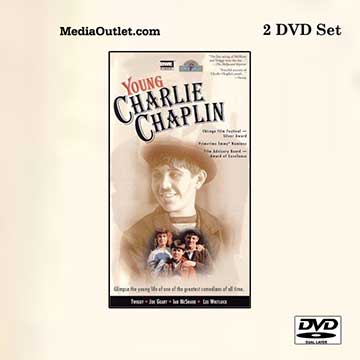
April 16, 1889: #BOTD: #HBD! Charlie
Chaplin, English comic actor, comedian, filmmaker, movie star,
music hall performer, Vaudevillian and composer (d. December 25,
1977) is #born Charles Spencer Chaplin in London. Sir Charles
Spencer Chaplin, KBE rose to fame in the era of silent film.
Chaplin became a worldwide icon through his screen persona "the
Tramp" and is considered one of the most important figures in
the history of the film industry. His career spanned more than 75
years, from childhood in the Victorian era until a year before his
death in 1977, and encompassed both adulation and controversy.
Chaplin's childhood in London was one of poverty and hardship.
When he was 14, his mother was committed to a mental asylum.
Chaplin began performing at an early age, touring music halls and
later working as a stage actor and comedian. At 19, he was signed
to the prestigious Fred Karno company, which took him to America.
Chaplin was scouted for the film industry and began appearing in
1914 for Keystone Studios. He soon developed the Tramp persona and
formed a large fan base. Chaplin directed his own films from an
early stage and continued to hone his craft as he moved to the
Essanay, Mutual, and First National corporations. By 1918, he was
one of the best-known figures in the world. In 1919, Chaplin
co-founded the distribution company United Artists, which gave him
complete control over his films. His first feature-length was The
Kid (1921), followed by A Woman of Paris (1923), The Gold Rush
(1925), and The Circus (1928). He refused to move to sound films
in the 1930s, instead producing City Lights (1931) and Modern
Times (1936) without dialogue. Chaplin became increasingly
political, and his next film, The Great Dictator (1940), satirised
Adolf Hitler, who bore a remarkable resemblance to Chaplin. The
1940s were a decade marked with controversy for Chaplin, and his
popularity declined rapidly. He was accused of communist
sympathies, while his involvement in a paternity suit and
marriages to much younger women caused scandal. An FBI
investigation was opened, and Chaplin was forced to leave the
United States and settle in Switzerland. He abandoned the Tramp in
his later films, which include Monsieur Verdoux (1947), Limelight
(1952), A King in New York (1957), and A Countess from Hong Kong
(1967). Chaplin wrote, directed, produced, edited, starred in, and
composed the music for most of his films. His films are
characterised by slapstick combined with pathos, typified in the
Tramp's struggles against adversity. Many contain social and
political themes, as well as autobiographical elements. In 1972,
as part of a renewed appreciation for his work, Chaplin received
an Honorary Academy Award for "the incalculable effect he has
had in making motion pictures the art form of this century".
In 1975, he was knighted by Queen Elizabeth II. He continues to be
held in high regard, with The Gold Rush, City Lights, Modern
Times, and The Great Dictator often ranked on industry lists of
the greatest films of all time. Charlie Chaplin died aged 88 in
the early morning hours at his home in Corsier-sur-Vevey,
Switzerland after having a stroke in his sleep. His funeral, on
December 27, was a small and private Anglican ceremony, according
to his wishes. Chaplin is interred in the Corsier-sur-Vevey
cemetery. Among the film industry's tributes, director Rene Clair
wrote, "He was a monument of the cinema, of all countries and
all times... the most beautiful gift the cinema made to us."
Actor Bob Hope declared, "We were lucky to have lived in his
time." Chaplin left more than 100M USD to his widow. On March
1, 1978, Chaplin's coffin was dug up and stolen from its grave by
Roman Wardas and Gantcho Ganev. The body was held for ransom in an
attempt to extort money from his widow, Oona Chaplin. The pair
were caught in a large police operation in May, and Chaplin's
coffin was found buried in a field in the nearby village of
Noville. It was re-interred in the Corsier cemetery in a
reinforced concrete vault. On Sale @ 15% Off Discount Till
Midnight PT!
https://store.earthstation1.com/young-charlie-chaplin-tv-miniseries-1989-dvd-2-19892.html
Today's
EarthStation1.com 15% Off Commemorative Memorial Title: Calling
America: Axis WW2 Radio Propaganda MP3 CD Download USB Drive
Today, April 16, 2026
April 16, 1896: #BOTD: Robert Henry Best,
known as Robert H. Best as a Nazi propaganda radio broadcaster
during World War II, disgrace to the Masonic fraternity, American
journalist, foreign correspondent who covered events in Europe for
American media outlets during the Interwar period, convicted of
treason in 1948 and sentenced to life imprisonment (d. December
16, 1952) is #born in Sumter, South Carolina, a son of Rev. Albert
Hartwell Best, a Methodist minister. After graduating from Wofford
College in 1916, he joined the United States Army Coast Artillery
Corps in October 1917. He was commissioned in 1918 and stayed in
the U.S. Army until 1920. Then he went to the School of Journalism
at Columbia University, from which he graduated in 1922. With the
money from a $1,500 Pulitzer Traveling Scholarship (ironic since
Pulitzer was Jewish), he traveled extensively in Europe, arriving
in Vienna in 1923, where he settled and found work as a foreign
freelance news correspondent for the United Press. He also
contributed articles to The New York Times, Chicago Daily News,
Time and Newsweek. During this Interwar period, Best covered
events in Central Europe from his headquarters in Vienna. The
foreign journalists of the period met daily at the Cafe Louvre in
Vienna, where Best and Marcel Fodor presided at the stammtisch
('regulars' table') where journalists and their friends socialized
and shared information. "He was, in a way, a Vienna
institution." Dan Durning summarizes the Vienna milieu in
which Best played a leading role: "Best cut a flamboyant
figure at his reserved table in the Cafe Louvre. A broad-brimmed
Stetson capped his 220-pound frame, and his high-laced shoes and
wretched German were familiar to other habitues of Ringstrasse...
Scheu, recalling the evenings at Cafe Louvre, wrote: "Best...
sat in a padded loge, with a view of Renngasse, that was reserved
for him." In addition to the foreign journalists in Vienna
around him, Best also "assembled a large number of refugees,
hangers on, news tipsters, spies -- serious, but questionable
people, who sat at his table and populated the surrounding tables
at Cafe Louvre....People who came from abroad were astounded by
what they saw at Cafe Louvre." Best gradually fell under Nazi
influence following the annexation of Austria by Nazi Germany, the
Anschluss, on March 12, 1938. In July 1941, United Press fired him
for 'nonperformance', thus putting him in financial difficulties.
He then made an approach to German State Radio for employment, but
with no immediate success. When the United States declared war on
Nazi Germany on December 11, 1941, Best was arrested along with
other U.S. reporters and held for deportation at an internment
camp in Bad Nauheim. There he decided to withdraw from the group
of exchangeable Americans and remain with his fiancee Erna Maurer,
an Austrian reporter for the Associated Press, whom he married on
September 2, 1942. Best then received permission to travel to
Berlin unaccompanied where he met Werner Plack, a member of the
Radio Division of the Foreign Office, who recruited him as a
commentator for German State Radio. In "one of the most
astounding Benedict Arnold cases of modern times," Best
began, in April 1942, as a news editor and commentator for the
Reichs-Rundfunk-Gesellschaft, German State Radio, working in the
U.S.A Zone. He broadcast talks to the U.S. under the pseudonym of
'Mr. Guess Who' presenting 'B.B.B.' (Best's Berlin Broadcasts).
Best maintained nominal anonymity, stating during his first
broadcast for Radio Berlin on April 10, 1942: "Who are you,
anyway? This is one of many questions which many would like to put
to me at this moment. But unfortunately, I must remain for you
merely 'Mr. Guess Who,' your self-appointed correspondent for the
New World Order." His primary propaganda targets were
President Franklin D. Roosevelt, Winston Churchill, the Jews and
the Soviet Union. John Carver Edwards, author of Berlin Calling:
American Broadcasters in Service to the Third Reich said: "Best's
broadcasts continued to blast the alleged enemies of Germany with
unbridled vehemence. He ranted against 'funny Frankie,' FDR, as
the dupe of America's Jewish interest, inveighed against the
Semitic takeover of Masonic lodges in the United States (Best was
a 32-degree Mason) and recounted lurid tales of Soviet cannibalism
on the eastern front." On April 13, 1945, Best's program was
not broadcast as scheduled. Instead, Best fled his Vienna
apartment, according to Edwards, but he forgot a cache of personal
papers that would later help to convict him. Recordings of some of
Best's broadcasts are located in Record Group 60 General Records
of the Department of Justice-Sound Recordings at the National
Archives, Washington, DC. Best was notable for continuously making
suggestions to his superiors of ways to heighten the effectiveness
of German psychological warfare. On July 26, 1943, Best along with
Fred W. Kaltenbach, Douglas Chandler, Edward Delaney, Constance
Drexel, Jane Anderson, Max Otto Koischwitz and Ezra Pound had been
indicted in absentia by a District of Columbia grand jury on
charges of treason. Best was arrested on January 29, 1946, by
British forces in Carinthia, Austria and handed over to the U.S.
Army. He was then flown to the United States to stand trial,
arriving in Massachusetts on December 14, 1946. Best was arraigned
on January 20, 1947, and stood trial at the Boston Federal
District Court on March 29, 1948. He acted as his own lawyer
before U.S. District Judge Francis Ford. The witnesses at his
trial included Princess Sofia zur Lippe-Weissenfeld of Austria and
fellow American-born Nazi propagandist Edward Vieth Sittler. On
April 16, 1948, Best was convicted of 12 counts of treason, with
the jury's special finding that he actually gave "aid and
comfort to the enemy". He had admitted in court the
authorship of his broadcasts. He was sentenced to life
imprisonment and fined $10,000. Best appealed his conviction in
1950 (Best v. United States., 184 F.2d 131 (1st Cir. 1950)). Best
once more acted as his own lawyer. The appeal court affirmed the
judgment of the District Court. Best further appealed to the U.S.
Supreme Court which refused to review the treason conviction on
February 27, 1951. Journalist William L. Shirer, author of The
Rise and Fall of the Third Reich, in 1942 broke the story of
Best's propaganda work for the Nazi regime and in 1948 testified
at Best's trial for treason. Soon afterward, Shirer released a
novel The Traitor (1950) in which "the main characters were
journalists resembling Shirer and Best." Robert Henry Best
died of a brain hemorrhage at the Federal Correctional
Institution, Danbury in Springfield, Missouri, aged 56. Best
served his sentence at the federal prison in Danbury, Connecticut.
On August 12, 1951, he was transferred to the Medical Center For
Federal Prisoners In Springfield, Missouri, where he died. He was
buried at the Pacolet Methodist Church Cemetery, Pacolet, South
Carolina, on December 21, 1952. Fellow Nazi propagandist Herbert
John Burgman, another American who created broadcasts in support
of the Nazi regime, died at the same prison as Best on the first
anniversary of Best's death. On Sale @ 15% Off Discount Till
Midnight PT!
https://store.earthstation1.com/calling-america-axis-ww2-radio-propaganda-mp3-23.html
Today's
EarthStation1.com 15% Off Commemorative Memorial Title: Philby
Burgess & Maclean: Anthony Bate Derek Jacobi DVD, Download,
USB
Today, April 16, 2026
April 16, 1911: #BOTD: Guy Burgess,
British diplomat, Soviet agent and traitor, a member of the
Cambridge Five spy ring that operated from the mid-1930s to the
early years of the Cold War era (d. August 30, 1963) is #born Guy
Francis de Moncy Burgess in Devonport (formerly named Plymouth
Dock or just Dock), Plymouth, South West England into a wealthy
middle-class family. Guy Burgess' defection in 1951 to the Soviet
Union, with his fellow-spy Donald Maclean, led to a serious breach
in Anglo-United States intelligence co-operation, and caused
long-lasting disruption and demoralisation in Britain's foreign
and diplomatic services. Burgess was educated at Eton College, the
Royal Naval College, Dartmouth and Trinity College, Cambridge. An
assiduous networker, he embraced left-wing politics at Cambridge
and joined the Communist Party. He was recruited by Soviet
intelligence in 1935, on the recommendation of Kim Philby. After
leaving Cambridge, Burgess worked for the BBC as a producer,
briefly interrupted by a short period as a full-time MI6
intelligence officer, before joining the Foreign Office in 1944.
At the Foreign Office, Burgess acted as a confidential secretary
to Hector McNeil, the deputy to Ernest Bevin, the Foreign
Secretary. This post gave Burgess access to secret information on
all aspects of Britain's foreign policy during the critical
post-1945 period, and it is estimated that he passed thousands of
documents to his Soviet masters. In 1950 he was appointed second
secretary to the British Embassy in Washington, a post from which
he was sent home after repeated misbehaviour. Although not at this
stage under suspicion, Burgess nevertheless accompanied Maclean
when the latter, on the point of being unmasked, fled to Moscow in
May 1951. Burgess's whereabouts were unknown in the West until
1956, when he appeared with Maclean at a brief press conference in
Moscow, claiming that his motive had been to improve Soviet-West
relations. He never left the Soviet Union; he was often visited by
friends and journalists from Britain, most of whom reported on a
lonely and empty existence. He remained unrepentant to the end of
his life, rejecting the notion that his earlier activities
represented treason. He was well provided for materially, but as a
result of his lifestyle his health deteriorated, and he died of
acute liver failure in Moscow, Soviet Union, aged 52. He is buried
in St John the Evangelist Churchyard in West Meon, City of
Winchester, Hampshire, England. Experts have found it difficult to
assess the extent of damage caused by Burgess's espionage
activities, but consider that the disruption in Anglo-American
relations caused by his defection was perhaps of greater value to
the Soviets than any information he provided. Burgess's life has
frequently been fictionalised, and dramatised in productions for
screen and stage. On Sale @ 15% Off Discount Till Midnight PT!
https://store.earthstation1.com/philby-burgess-amp-maclean-dvd-anthony-bate-derek-jacobi.html
Today's
EarthStation1.com 15% Off Commemorative Memorial Title: 6 Volume
Goon Show Audio/Video MegaSet DVD, MP4 Download, USB Drive
Today, April 16, 2026
April 16, 1918: #BOTD: #HBD! Spike
Milligan, British-Irish comedian, writer, musician, poet,
playwright and actor (d. February 27, 2002) is #born Terence Alan
Milligan in Ahmednagar, India, the son of an Irish father, Captain
Leo Alphonso Milligan, MSM, RA (1890-1969), who was serving in the
British Indian Army, and an English mother, Florence Mary Winifred
(nee Kettleband; 1893-1990). He is considered by many to have been
Great Britain's greatest comedian of the twentieth century.
Millligan spent his early life in India where he was born. The
majority of his working life was spent in the United Kingdom. He
disliked his first name, and began to call himself "Spike"
after hearing Spike Jones and his City Slickers on Radio
Luxembourg. He is most famous as the co-creator, main writer and a
principal cast member of the groundbreaking British radio
programme, The Goon Show, performing a range of roles including
the popular Eccles and Minnie Bannister characters. The Goon Show
also starred Peter Sellers, Harry Secombe and Michael Bentine.
Milligan wrote and edited many books, including Puckoon and his
seven-volume autobiographical account of his time serving during
the Second World War, beginning with Adolf Hitler: My Part in His
Downfall. He is also noted as a popular writer of comical verse;
much of his poetry was written for children, including Silly Verse
for Kids (1959). After success with The Goon Show, Milligan
translated this success to television with the Q series of
television shows (Q5, Q6, Q7, Q8 ,etc.) which were surreal sketch
shows that were a primary inspiration for Monty Python' Flying
Circus. He was the earliest-born, longest-lived and last surviving
member of the Goons. His producer, George Martin, was also the
producer of The Beatles, whose humor was largely inspired by the
Goon Shows they listened to when growing up in Liverpool. When the
Commonwealth Immigrants Act removed Indian-born Milligan's
automatic right to British citizenship in 1962, he became an Irish
citizen, exercising a right conferred through his Irish-born
father. Spike Milligan died of kidney failure at the age of 83 at
his home near Rye, Sussex. Even late in life, Milligan's black
humour had not deserted him. After the death of Harry Secombe from
cancer, he said, "I'm glad he died before me, because I
didn't want him to sing at my funeral." (A recording of
Secombe singing was played at Milligan's memorial service.) He
also wrote his own obituary, in which he stated repeatedly that he
"wrote the Goon Show and died". On the day of his March
8, 2002 funeral, his coffin was carried to St Thomas Church in
Winchelsea, East Sussex, and was draped in the flag of Ireland. He
had once quipped that he wanted his headstone to bear the words "I
told you I was ill." He was buried at St Thomas' churchyard
but the Chichester diocese refused to allow this epitaph. A
compromise was reached with the Irish translation of "I told
you I was ill", Duirt me leat go raibh me breoite and in
English, "Love, light, peace". The additional epitaph
"Gra mhor ort Shelagh" can be read as "Great love
for you Shelagh", referring to his wife. According to a
letter published in the Rye and Battle Observer in 2011,
Milligan's headstone was removed from St Thomas' churchyard in
Winchelsea and moved to be alongside the grave of his wife, but
was later returned. On Sale @ 15% Off Discount Till Midnight PT!
https://store.earthstation1.com/6-disc-goon-show-discount-valuepack-5-dvd-videos--1-mp36513.html
Today's
EarthStation1.com 15% Off Commemorative Memorial Title: Mahatma
Mohandas Gandhi Documentaries DVD MP4 Download USB Drive
Today, April 16, 2026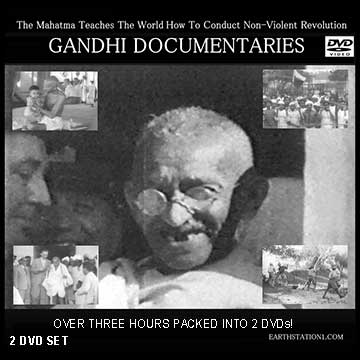
April 16, 1919: India: The History Of
India: The British Raj (Crown Rule In India, Direct Rule In India,
India, The Indian Empire): Nonviolent Resistance (Nonviolent
Action): Satyagraha (Sanskrit: Satya, "Truth"; Agraha,
"Insistence", "Holding Firmly To"); "Holding
Firmly To Truth", "Truth Force"): Civil
Disobedience: The Rowlatt Act: The Jallianwala Bagh Massacre (The
Amritsar Massacre): -- Mohandas Gandhi organizes a day of "prayer
and fasting" in response to the killing of Indian protesters
in the Jallianwala Bagh massacre by the British colonial troops
three days earlier. On April 13, 1919, troops of the British
Indian Army under the command of Colonel Reginald Dyer fired
rifles into a crowd of Baishakhi pilgrims, who had gathered in
Jallianwala Bagh, Amritsar, Punjab. The civilians, in the majority
Sikhs, had assembled to participate in the annual Baisakhi
celebrations, a religious and cultural festival for Punjabi people
and also to condemn the arrest and deportation of two national
leaders, Satya Pal and Dr Saifuddin Kitchlew. Coming from outside
the city, many may have been unaware of the imposition of martial
law earlier that day. The Jallianwalla Bagh is a public garden of
6 to 7 acres (28,000 m2), walled on all sides, with five
entrances. To enter, troops first blocked the entry by a tank and
locked the exit. On Dyer's orders, his troops fired on the crowd
for ten minutes, directing their bullets largely towards the few
open gates through which people were trying to flee. The British
Government released figures stating 379 dead and 1,200 wounded.
The casualty number estimated by the Indian National Congress was
more than 1,500 injured, with approximately 1,000 dead. This
"brutality stunned the entire nation", resulting in a
"wrenching loss of faith" of the general public in the
intentions of the UK. The ineffective inquiry and the initial
accolades for Dyer by the House of Lords fuelled widespread anger,
leading to the Non-cooperation Movement of 1920-22. On Sunday, 13
April 1919, Dyer was convinced of a major insurrection and he
banned all meetings; however this notice was not widely
disseminated. That was the day of Baisakhi, the main Sikh
festival, and many villagers had gathered in the Bagh. On hearing
that a meeting had assembled at Jallianwala Bagh, Dyer went with
Sikh, Gurkha, Baluchi, Rajput troops from 2-9th Gurkhas, the 54th
Sikhs and the 59th Sind Rifles to a raised bank and ordered them
to shoot at the crowd. Dyer continued the firing for about ten
minutes, until the ammunition supply was almost exhausted. Dyer
stated that 1,650 rounds had been fired, a number apparently
derived by counting empty cartridge cases picked up by the troops.
Dyer was initially lauded by conservative forces in the empire,
but in July 1920 he was censured and forced to retire by the House
Of Commons. He became a celebrated hero in the UK among most of
the people connected to the British Raj, for example, the House of
Lords, but unpopular in the House Of Commons, which voted against
Colonel Reginald Dyer. He was disciplined by being removed from
his appointment, was passed over for promotion and was prohibited
from further employment in India. Among his prominent supporters,
Nobel Literature Prize winner Rudyard Kipling called Dyer "the
man who saved India" and initiated collections for his
homecoming prize. The massacre caused a re-evaluation of the
army's role, in which the new policy became minimum force. The
army was retrained and developed less violent tactics for crowd
control. Historians consider the episode a decisive step towards
the end of British rule in India. On Sale @ 15% Off Discount Till
Midnight PT!
https://store.earthstation1.com/mahatma-mohandas-gandhi-nonviolent-revolution-biography-dvd.html
Today's
EarthStation1.com 15% Off Commemorative Memorial Title: War Jets:
Duel Over Korea: F-86 Sabre Vs MiG-15 Fagot MP4 Download DVD
Today, April 16, 2026
April 16, 1921: #BOTD: #HBD! Peter
Ustinov, English-Swiss actor, producer, writer, dramatist,
filmmaker, theatre and opera director, stage designer,
screenwriter, comedian, humorist, newspaper and magazine
columnist, radio broadcaster, and television presenter (d. March
28, 2004) is #born Peter Alexander Von Ustinov at 45 Belsize Park,
London, England. Sir Peter Alexander Ustinov, CBE, FRSA was a
fixture on television talk shows and lecture circuits for much of
his career. A respected intellectual and diplomat, he held various
academic posts and served as a Goodwill Ambassador for UNICEF and
President of the World Federalist Movement. Ustinov was the winner
of numerous awards over his life, including two Academy Awards for
Best Supporting Actor, Emmy Awards, Golden Globes and BAFTA Awards
for acting, and a Grammy Award for best recording for children, as
well as the recipient of governmental honours from, amongst
others, the United Kingdom, France, and Germany. He displayed a
unique cultural versatility that has frequently earned him the
accolade of a Renaissance man. Miklos Rozsa, composer of the music
for Quo Vadis and of numerous concert works, dedicated his String
Quartet No. 1, Op. 22 (1950) to Ustinov. In 2003, Durham
University changed the name of its Graduate Society to Ustinov
College in honour of the significant contributions Ustinov had
made as chancellor of the university from 1992 until his death of
heart failure in a clinic in Genolier, near his home in Bursins,
Switzerland, aged 82. He had suffered from diabetes and heart
disease. He is buried in Bursins Cemetery in Bursins, Switzerland.
UNICEF Executive Director Carol Bellamy spoke at his funeral,
representing United Nations Secretary-General Kofi Annan. On Sale
@ 15% Off Discount Till Midnight PT!
https://store.earthstation1.com/war-jets-duel-over-korea-f86-sabre-vs-mig15-fagot-mp4-downloa86154.html
Today's
EarthStation1.com 15% Off Commemorative Memorial Title: Betty Boop
Special Collector's Edition I & II DVD, Download, USB Drive
Today, April 16, 2026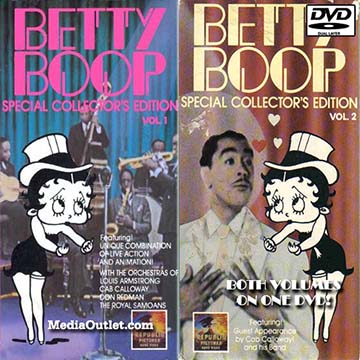
April: 16, 1924: Music: Music History:
Music Of The United States: African-American Music: Jazz: The
History Of Jazz: Scat Singing: -- Don Redman, African American
jazz musician, arranger, bandleader, and composer, makes recording
history when he performs the first recorded scat vocals while
singing as a member of Fletcher Henderson's Orchestra. Redman
scatted a few bars of "My Papa Doesn't Two-Time No Time"
in the first third of the song, recorded in New York City by
Columbia Records. Although Louis Armstrong is famously credited
with having recorded the first scat vocals with the Louis
Armstrong And His Hot Five band on February 26, 1926 during the
song "Heebie Jeebies", Don Redman actually preceded him
by almost two years. Scat singing or scatting is vocal
improvisation with wordless vocables, nonsense syllables or
without words at all. In scat singing, the singer improvises
melodies and rhythms using the voice solely as an instrument
rather than a speaking medium. This is different from vocalese,
which uses recognizable lyrics that are sung to pre-existing
instrumental solos. On Sale @ 15% Off Discount Till Midnight PT!
https://store.earthstation1.com/betty-boop-special-collector39s-editions-i-and-ii-dual-layer-d39.html
Today's
EarthStation1.com 15% Off Commemorative Memorial Title: The Good
Old Time TV Theme Song MP3 CD, Audio Download, USB Drive
Today, April 16, 2026
April 16, 1924: #BOTD: #HBD! Henry
Mancini, American composer, conductor, arranger, pianist and
flautist (d. June 14, 1994) is #born Enrico Nicola Mancini. Often
cited as one of the greatest composers in the history of film,
Henry Nicola Mancini won four Academy Awards, a Golden Globe, and
twenty Grammy Awards, plus a posthumous Grammy Lifetime
Achievement Award in 1995. His works include the theme and
soundtrack for the Peter Gunn television series as well as the
music for The Pink Panther film series ("The Pink Panther
Theme") and "Moon River" from Breakfast at
Tiffany's. The Music from Peter Gunn won the first Grammy Award
for Album of the Year. Mancini also enjoyed a long collaboration
composing film scores for the film director Blake Edwards. Mancini
also scored a #1 hit single during the rock era on the Billboard
charts: his arrangement and recording of the "Love Theme from
Romeo and Juliet" spent two weeks at the top, beginning on
June 29, 1969. Henry Mancini died of pancreatic cancer in Los
Angeles, California, aged 70. He was working at the time on the
Broadway stage version of Victor/Victoria, which he never saw on
stage. On Sale @ 15% Off Discount Till Midnight PT!
https://store.earthstation1.com/tv-theme-song-mp3-cd-classic-old-time-televisio3.html
Today's
EarthStation1.com 15% Off Commemorative Memorial Title: Cinderella
1957 Rodgers & Hammerstein Julie Andrews DVD Download USB
Today, April 16, 2026
April 16, 1927: #BOTD: #HBD! Edie Adams,
American comedienne, actress, singer, businesswoman and beauty,
Miss U.S. Television. Tony Award winner, Theatre World Award
winner and an Emmy Award nominee (d. October 15, 2008) is #born
Edith Elizabeth Enke in Kingston, Pennsylvania, the only daughter
of Sheldon Alonzo Enke and his wife, Ada Dorothy (nee Adams).
Adams was well known for her impersonations of sexy stars on stage
and television, especially Marilyn Monroe. She was the frequent
television partner of Ernie Kovacs, her husband. Adams founded two
beauty businesses: Edie Adams Cosmetics and Edie Adams Cut 'n'
Curl, and was a long-time spokesperson for Muriel Cigars. Adams
had an elder brother, Sheldon Adams Enke. The family moved to
nearby areas such as Shavertown, Grove City and Trucksville and
spent a year in New York City before settling in Tenafly, New
Jersey, where she attended Tenafly High School. Ada Enke taught
her daughter singing and piano; mother and daughter were members
of the Grove City Presbyterian church choir. Adams's grandmother,
a seamstress, taught her how to sew. She made her own clothing
beginning in the sixth grade and Adams would later have her own
designer line of clothing, called Bonham, Inc. She earned a vocal
degree from Juilliard and then graduated from Columbia School of
Drama. She studied at the Actors Studio in New York and at the
Traphagen School of Fashion. Initially, Adams could not decide
whether to pursue a career in fashion design or music, so she
tossed a coin, and music won. In 1949-50, she appeared in the
early live television show Bonnie Maid's Versatile Varieties as
one of the original "Bonnie Maids" doing live
commercials for the sponsor. In 1950, she won the "Miss U.S.
Television" beauty contest, which led to an appearance with
Milton Berle on his television show. Her earliest television work
billed her as Edith Adams. One of her early appearances was on
Arthur Godfrey's Talent Scouts. She was seen by the producer of
the Ernie Kovacs show Three to Get Ready (in Philadelphia), who
invited her to audition. Adams had very little experience with
popular music and could perform only three songs. She later
stated: "I sang them all during the audition, and if they had
asked to hear another, I never would have made it." She
became part of the show in July 1951. Adams had never seen the
program she was hired for. When he saw his daughter on the show,
Adams's father was upset to find her role involved trying to avoid
pies in the face. In one of his last interviews, Kovacs looked
back on the early days, saying, "I wish I could say I was the
big shot that hired her, but it was my show in name only - the
producer had all the say. Later on I did have something to say and
I said it, 'Let's get married.'" The year following, Kovacs
and Adams went on to be paired on the WPTZ Philadephic television
station's networked daytime television comedy/variety show Kovacs
On The Corner. Thereafter, Adams continued working regularly with
Kovacs on television, particularly with TV talk show pioneer Jack
Paar. After a courtship that included mariachi bands and an
unexpected diamond engagement ring, Adams and Kovacs eloped; they
were married on September 12, 1954, in Mexico City. Adams was
initially uncertain about marrying Kovacs. She went on a six-week
European cruise, hoping to come to a decision. After three days
away and many long-distance phone calls, Adams returned home with
an answer: yes. It was Kovacs's second marriage and lasted until
his death in a car accident on January 13, 1962. Adams and Kovacs
received Emmy nominations for best performances in a comedy series
in 1957. In 1960, she and Kovacs played themselves in The
Lucy-Desi Comedy Hour final television special on CBS, during
which she performed the send-off song "That's All".
Adams made two appearances on What's My Line? (once as "Edith
Adams (Mrs. Ernie Kovacs)" while her husband was on the
panel; once as Edie Adams). Adams starred on Broadway in Wonderful
Town (1953) opposite Rosalind Russell (winning the Theatre World
Award), and as Daisy Mae in Li'l Abner (1956), winning the Tony
Award for Best Featured Actress in a Musical. She played the Fairy
Godmother in Rodgers and Hammerstein's original Cinderella
broadcast in 1957, which was the most watched television show in
history at that time. Adams was to play Daisy Mae in the film
version of Li'l Abner but was unable to due to the late arrival of
her daughter, Mia Susan Kovacs. After Kovacs's death, his network,
ABC, gave Adams a chance with her own show, Here's Edie, which
received five Emmy nominations but lasted one season, in 1963.
Kovacs was a noted cigar smoker, and Adams did a long-running
series of TV commercials for Muriel Cigars. She remained the
pitch-lady for Muriel well after Kovacs's death, intoning in a Mae
West style and sexy outfit, "Why don't you pick one up and
smoke it sometime?" Another commercial for Muriel Cigars,
which cost 10 cents, showed Adams singing, "Hey, big spender,
spend a little dime with me" (based on the song "Big
Spender" from the musical Sweet Charity). Adams's cigar
commercials made her one of the top three most-recognizable
television celebrities. In subsequent years, Adams made sporadic
television appearances, including on Fantasy Island, The Love
Boat, McMillan & Wife, Murder, She Wrote and Designing Women.
Adams played supporting roles in several films in the 1960s,
including the embittered secretary of two-timing Fred MacMurray in
the Oscar-winning film The Apartment (1960). She was the wife of a
presidential candidate (played by Cliff Robertson) in The Best Man
(1964) and was reunited with Robertson for the comedy The Honey
Pot (1967). In 2003, as one of the surviving headliners from the
all-star comedy It's a Mad, Mad, Mad, Mad World (1963), she joined
actors Marvin Kaplan and Sid Caesar at a 40th anniversary
celebration of the film. She was also a successful nightclub
headliner. Shortly after her husband's death, Adams won a "nasty
custody battle" with Kovacs's ex-wife over Edie's
stepdaughters. His ex-wife had previously kidnapped the girls
during a visit years before; because Kovacs was their legal
guardian, he and Edie had worked tirelessly to locate his
daughters and bring them home. Another court battle began for
Adams in the same year, this time with her mother-in-law, who
refused to believe there were more debts than assets in her son's
estate. Mary Kovacs accused her daughter-in-law of mismanaging the
estate and petitioned for custody of her granddaughters. The
dispute lasted for years, with Adams remaining the administrator
of her husband's estate and guardian of the three girls. She
worked for years to pay her late husband's tax debt to the IRS.
The couple's celebrity friends planned a TV special benefit for
Edie and her family, but she declined, saying, "I can take
care of my own children." She spent the next year working
practically non-stop. Adams started her own businesses, Edie Adams
Cosmetics, which sold door-to-door, and Edie Adams Cut 'n' Curl
beauty salons, which she began in 1967. She once owned a 160-acre
(65 ha) California almond farm and was the spokeswoman for Sun
Giant nuts. Because of her 20 years of commercials for Muriel
Cigars (retiring in 1976) and her successful business ventures,
Adams went from being mired in debt after Kovacs's fatal accident
in 1962 to being a millionaire in 1989. After Kovacs's death,
Adams was married two more times. In 1964, she married
photographer Martin Mills. In 1972, she married trumpeter Pete
Candoli, with whom she appeared in a touring production of the
Cole Porter musical Anything Goes. In addition to raising
stepdaughters Bette and Kippie from her marriage to Kovacs, Adams
gave birth to daughter Mia Susan Kovacs (killed in an automobile
accident in 1982), and son Joshua Mills. Adams was a Republican
and campaigned for Dwight Eisenhower's re-election during the 1956
presidential election. Adams was an early advocate of civil
rights, frequently lending her support to the movement at
celebrity events and on her own television show during the early
sixties. She insisted that her duet with Sammy Davis Jr. on her
variety show Here's Edie be staged so that they were seated next
to each other - as equals. Prior to that, entertainers of
different races and sexes were unable to perform next to one
another, so that one had to be in front of or behind the other.
However, the New York City Ballet had a televised performances of
the ballet "Agon" (a ballet costumed in leotards and
tights, choreographed 1957) with Arthur Mitchell (original cast
and the first black principal dancer at the New York City Ballet)
partnering ballerina Diana Adams (original cast) dating from 1960.
Adams died in Los Angeles, California, on October 15, 2008, at age
81, from cancer and pneumonia. She was interred in Forest Lawn
Memorial Park, Hollywood Hills, alongside her first husband Ernie,
between her daughter, Mia, and her stepdaughter, Kippie. After her
death an article in The New York Times said that her work "both
embodied and winked at the stereotypes of fetching chanteuse and
sexpot blonde". Adams archived her husband's television work,
which she described during a 1999 videotaped interview with the
Archive of American Television. She later testified on the status
of the archive of the short-lived DuMont Television Network, where
both she and husband Kovacs worked during the early 1950s. Adams
claimed that so little value was given to the film archive that
the entire collection was loaded into three trucks and dumped into
Upper New York Bay in front of the Statue Of Liberty. Upon
discovering that her husband's work was disappearing through being
discarded and re-use of the tapes, Adams initially used the
proceeds of his insurance policy and her own earnings to purchase
the rights to as much footage as possible. On Sale @ 15% Off
Discount Till Midnight PT!
https://store.earthstation1.com/cinderella-1957-rodgers-amp-hammerstein-julie-andrews-dvd-download1957.html
Today's
EarthStation1.com 15% Off Commemorative Memorial Title: Jack Benny
Presents Golden Memories Of Radio LPs CD, MP3 Download, USB
Today, April 16, 2026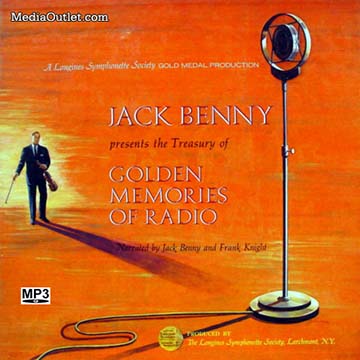
April 16, 1935: Premieres: Radio
Premieres: American Radio Premieres: -- Fibber McGee And Molly,
the American radio comedy series starring married couple Jim
Jordan and Marian Driscoll Jordan, premieres on the NBC Red
Network. Though it took three seasons to become an irrevocable
hit, it became the country's top-rated radio series, it became a
staple of the NBC Radio Network for the show's entire run and one
of the most popular and enduring radio series of its time. The
prime time situation comedy ran as a standalone series from 1935
to 1956, then continued as a short-form series as part of the
weekend Monitor from 1957 to 1959. The title characters were
created and portrayed by Jim and Marian Jordan, a real-life
husband and wife team that had been working in radio since the
1920s. Fibber McGee and Molly followed the adventures of a
working-class couple, the habitual storyteller Fibber McGee and
his sometimes terse but always loving wife Molly, living among
their numerous neighbors and acquaintances in the community of
Wistful Vista. As with most radio comedies of the era, Fibber
McGee and Molly featured an announcer, house band and vocal
quartet for interludes. At the peak of the show's success in the
1940s, it was adapted into a string of feature films; a 1959
attempt to adapt the series to television with a different cast
and new writers was both a critical and commercial failure, which,
coupled with Marian Jordan's death shortly thereafter, brought the
series to an end. On Sale @ 15% Off Discount Till Midnight PT!
https://store.earthstation1.com/jack-benny-presents-golden-memories-of-radio-6-album-set-mp3-63.html
Today's
EarthStation1.com 15% Off Commemorative Memorial Title: TV Music &
Dance Shows #5 Ready Steady Go! DVD, Download, Flash Drive
Today, April 16, 2026
April 16, 1939: #BOTD: #HBD! Dusty
Springfield, OBE, English pop singer, record producer and beauty
(d. March 2, 1999) is #born Mary Isobel Catherine Bernadette
O'Brien in West Hampstead, London Borough of Camden in north-west
London, England. Dusty Springfield's career extended from the late
1950s to the 1990s. With her distinctive sensual mezzo-soprano
sound, she was an important blue-eyed soul singer and at her peak
was one of the most successful British female performers, with six
top 20 singles on the US Billboard Hot 100 and sixteen on the UK
Singles Chart from 1963 to 1989. She is a member of the US Rock
and Roll and UK Music Halls of Fame. International polls have
named Springfield among the best female rock artists of all time.
Her image, supported by a peroxide blonde bouffant hairstyle,
evening gowns, and heavy make-up, as well as her flamboyant
performances made her an icon of the Swinging Sixties. Born in
West Hampstead to a family that enjoyed music, Springfield learned
to sing at home. In 1958 she joined her first professional group,
The Lana Sisters, and two years later formed a pop-folk vocal
trio, The Springfields, with her brother Tom Springfield and Tim
Field. They became the UK's top selling act. Her solo career began
in 1963 with the upbeat pop hit, "I Only Want to Be with
You". Among the hits that followed were "Wishin' and
Hopin'?" (1964), "I Just Don't Know What to Do with
Myself" (1964), "You Don't Have to Say You Love Me"
(1966), and "Son of a Preacher Man" (1968). As a fan of
US soul music, she brought many little-known soul singers to the
attention of a wider UK record-buying audience by hosting the
first national TV performance of many top-selling Motown artists
beginning in 1965. Partly owing to these efforts, a year later she
eventually became the best-selling female singer in the world and
topped a number of popularity polls, including Melody Maker's Best
International Vocalist. Although she was never considered a
Northern Soul artist in her own right, her efforts contributed a
great deal to the formation of the genre as a result. She was the
first UK singer to top the New Musical Express readers' poll for
Female Singer. To boost her credibility as a soul artist,
Springfield went to Memphis, Tennessee, to record Dusty in
Memphis, an album of pop and soul music with the Atlantic Records
main production team. Released in 1969, it has been ranked among
the greatest albums of all time by the US magazine Rolling Stone
and in polls by VH1 artists, New Musical Express readers, and
Channel 4 viewers. The album was also awarded a spot in the Grammy
Hall of Fame. Despite its current recognition, the album did not
sell well and after its release, Springfield experienced a career
slump for several years. However, in collaboration with Pet Shop
Boys, she returned to the Top 10 of the UK and US charts in 1987
with "What Have I Done to Deserve This?" Two years
later, she had two other UK hits on her own with "Nothing Has
Been Proved" and "In Private." Subsequently, in the
mid-1990s, owing to the inclusion of "Son of a Preacher Man"
on the Pulp Fiction soundtrack, interest in her early output was
revived. Dusty Springfield died of breast cancer in
Henley-on-Thames, England, aged 59. Springfield's funeral service
was attended by hundreds of fans and people from the music
business, including Elvis Costello, Lulu and Pet Shop Boys. It
took place at the Anglican St Mary The Virgin church in
Henley-On-Thames. A marker dedicated to her memory was placed in
the church graveyard. In accordance with Springfield's wishes, she
was cremated and some of her ashes were buried at Henley, while
the rest were scattered by her brother, Tom Springfield, at the
Cliffs of Moher in Ireland. On Sale @ 15% Off Discount Till
Midnight PT!
https://store.earthstation1.com/classic-tv-music-amp-dance-shows-5-ready-steady-go-dv5.html
Today's
EarthStation1.com 15% Off Commemorative Memorial Title: Ratlines
WWII Escape Routes For Fascist War Criminals MP4 Download DVD
Today, April 16, 2026
April 16, 1941: World War II: The
European Civil War: The Second European War (The European Theater
Of World War II): The Mediterranean And Middle East Theater Of
World War II: The Balkans Campaign (World War II): The Invasion Of
Yugoslavia (The April War, Operation 25): The Independent State Of
Croatia (Serbo-Croatian: Nezavisna Drzava Hrvatska [NDH]): -- The
Nazi-affiliated Ustashe Party of Croatia is put in charge of the
Independent State Of Croatia by the Axis powers after Operation
25, the Nazi Invasion Of Yugoslavia, is effected. The day before,
Ante Pavelic came to power over Croatia in the new Ustasha state
under the umbrella of German and Italian forces as German Fuhrer
Adolf Hitler and Italian Duce Benito Mussolini granted recognition
to the Croatian state and declared that their governments would be
glad to participate with the Croatian government in determining
its frontiers. The Independent State of Croatia (Serbo-Croatian:
Nezavisna Drzava Hrvatska, NDH; German: Unabhangiger Staat
Kroatien; Italian: Stato indipendente di Croazia) was a World War
II-era puppet state of Nazi Germany and Fascist Italy. It was
established in parts of occupied Yugoslavia on April 10, 1941,
after the invasion by the Axis powers. Its territory consisted of
most of modern-day Croatia and Bosnia and Herzegovina, as well as
some parts of modern-day Serbia and Slovenia, but also excluded
many Croat-populated areas in Dalmatia (until late 1943), Istria,
and Medimurje regions (which today are part of Croatia). During
its entire existence, the NDH was governed as a one-party state by
the fascist Ustasa organization. The Ustase was led by the
Poglavnik, Ante Pavelic. The regime targeted Serbs, Jews and Roma
as part of a large-scale campaign of genocide, as well as
anti-fascist or dissident Croats and Bosnian Muslims. According to
Stanley G. Payne, "crimes in the NDH were proportionately
surpassed only by Nazi Germany, the Khmer Rouge in Cambodia and
several of the extremely genocidal African regimes." In the
territory controlled by the Independent State of Croatia, between
1941 and 1945, there existed 22 concentration camps. The largest
camp was Jasenovac. Two camps, Jastrebarsko and Sisak, held only
children. The state was officially a monarchy after the signing of
the Laws of the Crown of Zvonimir on 15 May 1941. Appointed by
Victor Emmanuel III of Italy, Prince Aimone, Duke of Aosta
initially refused to assume the crown in opposition to the Italian
annexation of the Croat-majority populated region of Dalmatia,
annexed as part of the Italian irredentist agenda of creating a
Mare Nostrum ("Our Sea"). He later briefly accepted the
throne due to pressure from Victor Emmanuel III and was titled
Tomislav II of Croatia, but never moved from Italy to reside in
Croatia. From the signing of the Treaties of Rome on May 18, 1941
until the Italian capitulation on September 8, 1943, the state was
a territorial condominium of Germany and Italy. In its judgement
in the Hostages Trial, the Nuremberg Military Tribunal concluded
that NDH was not a sovereign state. According to the Tribunal,
"Croatia was at all times here involved an occupied country".
In 1942, Germany suggested Italy take military control of all of
Croatia out of a desire to redirect German troops from Croatia to
the Eastern Front. Italy, however, rejected the offer as it did
not believe that it could on its own handle the unstable situation
in the Balkans. After the ousting of Mussolini and the Kingdom of
Italy's armistice with the Allies, Tomislav II abdicated from his
Croatian throne: the NDH on 10 September 1943 declared that the
Treaties of Rome were null and void and annexed the portion of
Dalmatia that had been ceded to Italy. The NDH attempted to annex
Zara (modern-day Zadar, Croatia), which had been a recognized
territory of Italy since 1920 and long an object of Croatian
irredentism, but Germany did not allow it. On Sale @ 15% Off
Discount Till Midnight PT!
https://store.earthstation1.com/ratlines-wwii-escape-routes-for-fascist-war-criminals-mp4-download-dvd.html
Today's
EarthStation1.com 15% Off Commemorative Memorial Title:
Conspiracies Special Narrated By Joe Frank MP4 Video Download DVD
Today, April 16, 2026
April 16, 1943: Psychedelia: History Of
Psychedelia: Recreational Drugs: Psychoactive Drugs: Lysergic Acid
Diethylamide (German: Lysergsaure-Diethylamid {LSD] (Acid, Lucy):
The History Of LSD: The Discovery Of LSD: -- Swiss scientist
Albert Hofmann accidentally discovers the hallucinogenic effects
of the research drug LSD he synthesized from lysergic acid, a
chemical from the fungus ergot. Albert Hofmann joined the
pharmaceutical-chemical department of Sandoz Laboratories, located
in Basel, as a co-worker with professor Arthur Stoll, founder and
director of the pharmaceutical department. He began studying the
medicinal plant squill and the fungus ergot as part of a program
to purify and synthesize active constituents for use as
pharmaceuticals. His main contribution was to elucidate the
chemical structure of the common nucleus of Scilla glycosides (an
active principle of Mediterranean squill). While researching
lysergic acid derivatives, Hofmann first synthesized LSD on
November 16, 1938. The main intention of the synthesis was to
obtain a respiratory and circulatory stimulant (an analeptic). It
was set aside for five years, until April 16, 1943, when Hofmann
decided to take a second look at it. While re-synthesizing LSD, he
accidentally absorbed a small amount of the drug and discovered
its powerful effects. He described what he felt as being
"...affected by a remarkable restlessness, combined with a
slight dizziness. At home I lay down and sank into a not
unpleasant intoxicated-like condition, characterized by an
extremely stimulated imagination. In a dreamlike state, with eyes
closed (I found the daylight to be unpleasantly glaring), I
perceived an uninterrupted stream of fantastic pictures,
extraordinary shapes with intense, kaleidoscopic play of colors.
After about two hours this condition faded away." Three days
later, on what is now commemorated as "Bicycle Day"
Hofmann ingested 0.25 milligrams (250 micrograms) of the substance
on April 19, 1943. Between one and two hours later, Hofmann
experienced slow and gradual changes in his perception. He asked
his laboratory assistant to escort him home. As was customary in
Basel, they made the journey by bicycle. On the way, Hofmann's
condition rapidly deteriorated as he struggled with feelings of
anxiety, alternating in his beliefs that the next-door neighbor
was a malevolent witch, that he was going insane, and that the LSD
had poisoned him. When the house doctor arrived, however, he could
detect no physical abnormalities, save for a pair of widely
dilated pupils. Hofmann was reassured, and soon his terror began
to give way to a sense of good fortune and enjoyment, as he later
wrote: "... Little by little I could begin to enjoy the
unprecedented colors and plays of shapes that persisted behind my
closed eyes. Kaleidoscopic, fantastic images surged in on me,
alternating, variegated, opening and then closing themselves in
circles and spirals, exploding in colored fountains, rearranging
and hybridizing themselves in constant flux ..." The events
of this first LSD trip, now known as "Bicycle Day",
after the bicycle ride home, proved to Hofmann that he had indeed
made a significant discovery: a psychoactive substance with
extraordinary potency, capable of causing significant shifts of
consciousness in incredibly low doses. (The term trip was first
coined by US Army scientists during the 1950s when they were
experimenting with LSD.) Hofmann foresaw the drug as a powerful
psychiatric tool; because of its intense and introspective nature,
he could not imagine anyone using it recreationally. LSD was sold
as a medication for research purposes under the trade-name Delysid
beginning in the 1950s; it ceased selling it in the 1960s. After
World War II English psychiatrist Humphry Osmond began using LSD
as a form of psychedelic psychotherapy. In 1956, seeking a name
for the experience induced by LSD, Osmond contacted Aldous Huxley,
a personal acquaintance and a fellow advocate for the therapeutic
use of the substance. Huxley coined the term "phanerothyme,"
from the Greek terms for "manifest" and "spirit".
In a letter to Osmond, he wrote "To make this mundane world
sublime, Take half a gram of phanerothyme", to which Osmond
responded "To fathom Hell or soar angelic, Just take a pinch
of psychedelic". It was on this term that Osmond eventually
settled -- combining the ancient greek words psych (soul, mind)
and delein (to manifest), with the meaning "mind manifesting"
-- because it was "clear, euphonious and uncontaminated by
other associations." In the 1950s, the Central Intelligence
Agency (CIA) believed that the drug might be useful for mind
control, so they tested it on people, some without their
knowledge, in a program called MKUltra. Lysergic acid diethylamide
(LSD), also known as acid, is a hallucinogenic drug. Effects
typically include altered thoughts, feelings, and awareness of
one's surroundings. Many users see or hear things that do not
exist. Dilated pupils, increased blood pressure, and increased
body temperature are typical. Effects typically begin within half
an hour and can last for up to 12 hours. It is used mainly as a
recreational drug and as an entheogen (consciousness-altering
drug) for spiritual reasons. LSD does not appear to be addictive,
although tolerance may occur with use of increasing doses. Adverse
psychiatric reactions are possible, such as anxiety, paranoia, and
delusions. Distressing flashbacks might occur in spite of no
further use, a condition called hallucinogen persisting perception
disorder. Death is very rare as a result of LSD, though it
occasionally occurs in accidents. The effects of LSD are believed
to occur as a result of alterations in the serotonin system. As
little as 20 micrograms can produce an effect. In pure form, LSD
is clear or white in color, has no smell, and is crystalline. It
breaks down with exposure to ultraviolet light. About 10 percent
of people in the United States have used LSD at some point in
their lives as of 2017, while 0.7 percent have used it in the last
year. It was most popular in the 1960s to 1980s. LSD is typically
either swallowed or held under the tongue. It is most often sold
on blotter paper and less commonly as tablets or in gelatin
squares. There is no known treatment for addiction, if it occurs.
LSD was listed as a schedule 1 controlled substance by the United
Nations in 1971. It currently has no approved medical use. In
Europe, as of 2011, the typical cost of a dose was between 4.50 -
25 Euros. Albert Hofmann (January 11, 1906 - April 29, 2008) was a
Swiss scientist who, besides LSD, was also the first person to
isolate, synthesize, and name the principal psychedelic mushroom
compounds psilocybin and psilocin. He authored more than 100
scientific articles and numerous books, including LSD: Mein
Sorgenkind (LSD: My Problem Child). In 2007, he shared first place
with Tim Berners-Lee in a list of the 100 greatest living
geniuses, published by The Daily Telegraph newspaper. Albert
Hofmann, Swiss chemist, scientist and academic, the first person
to isolate, synthesize, ingest, name and learn of the psychedelic
effects of both LSD and the principal psychedelic mushroom
compounds psilocybin and psilocin (January 11, 1906 - April 29,
2008) was born in Baden, Switzerland. Albert Hofmann authored more
than 100 scientific articles and numerous books, including LSD:
Mein Sorgenkind (LSD: My Problem Child). In 2007, he shared first
place with Tim Berners-Lee in a list of the 100 greatest living
geniuses, published by The Daily Telegraph newspaper. Albert
Hofmann died at the age of 102 from a heart attack in Burg im
Leimental, Switzerland. His burial details are not publicly
disclosed. On Sale @ 15% Off Discount Till Midnight PT!
https://store.earthstation1.com/conspiracies-special-narrated-by-joe-frank-mp4-video-download-dvd.html
Today's
EarthStation1.com 15% Off Commemorative Memorial Title: Berlin:
The Doomed City + Bonus Germany Reunification MP4 Download DVD
Today, April 16, 2026
April 16, 1945: The European Civil War:
World War II: The Second European War (The European Theater Of
World War II): The Eastern Front Of World War II: The Great
Patriotic War (The German-Soviet War): The Battle Of Berlin (The
Berlin Strategic Offensive Operation, The Fall Of Berlin): The
Battle Of The Seelow Heights: -- The Red Army begins the final
assault on German forces around Berlin, with nearly one million
troops fighting in the Battle of the Seelow Heights, part of the
Seelow-Berlin Offensive Operation (April 16 - May 2, 1945). A
pitched battle (a battle in which both sides choose the fighting
location and time), it was one of the last assaults on large
entrenched defensive positions of the Second World War. It was
fought over three days, from 16-19 April 1945. Close to one
million Soviet soldiers of the 1st Belorussian Front (including
78,556 soldiers of the Polish 1st Army), commanded by Marshal
Georgi Zhukov, attacked the position known as the "Gates of
Berlin". They were opposed by about 110,000 soldiers of the
German 9th Army, commanded by General Theodor Busse, as part of
the Army Group Vistula. This battle is often incorporated into the
Battle of the Oder-Neisse. The Seelow Heights was where some of
the most bitter fighting in the overall battle took place, but it
was only one of several crossing points along the Oder and Neisse
rivers where the Soviets attacked. The Battle of the Oder-Neisse
was itself only the opening phase of the Battle of Berlin. The
result was the encirclement of the German 9th Army and the Battle
of Halbe. On Sale @ 15% Off Discount Till Midnight PT!
https://store.earthstation1.com/berlin-the-doomed-city-dvd-cities-at-war-wwii-germany.html
Today's
EarthStation1.com 15% Off Commemorative Memorial Title: 1940-1960:
The Iron Curtain And Beyond Cold War DVD, MP4, USB Drive
Today, April 16, 2026
April 16, 1947: The Aftermath Of World
War II: The Cold War: The "We Are Today In The Midst Of A
Cold War" Speech: -- Bernard Baruch, American financier,
statesman and influential advisor to Democratic presidents who
exerted great political and economic influence on world affairs
during the first half of the twentieth century, reads a speech
during the unveiling of his portrait in the South Carolina House
Of Representatives written by Algonquin Round Table member and
three-time recipient of The Pulitzer Prize For Reporting
journalist Herbert Bayard Swope, which proclaims "Let us not
be deceived: we are today in the midst of a cold war" to
describe the deteriorating relations between the United States and
the Soviet Union. Newspaper columnist Walter Lippmann gave the
term wide currency with his book The Cold War. When asked in 1947
about the source of the term, Lippmann traced it to a French term
from the 1930s, "La Guerre Froide". The descriptor "Cold
War" immediately found common currency in the public domain,
and became was the label of choice to refer to state of East-West
relations until the fall of the Soviet Union on December 26, 1991.
The definition of the term "cold war" has now become
fixed as a war waged through indirect conflict. Historically, a
Cold War is a state of conflict between nations that does not
involve direct military action but is pursued primarily through
economic and political actions, propaganda, acts of espionage or
proxy wars waged by surrogates. This term is most commonly used to
refer to the American-Soviet Cold War of 1947-1989. The surrogates
are typically states that are satellites of the conflicting
nations, i.e., nations allied to them or under their political
influence. Opponents in a cold war will often provide economic or
military aid, such as weapons, tactical support or military
advisors, to lesser nations involved in conflicts with the
opposing country. The expression "cold war" was rarely
used before 1945. Some writers credit the fourteenth century
Spaniard Don Juan Manuel for first using the term (in Spanish)
regarding the conflict between Christianity and Islam; however the
term employed was "tepid" rather than "cold".
The word "cold" first appeared in a faulty translation
of his work in the 19th century. In 1934, the term was used in
reference to a faith healer who received medical treatment after
being bitten by a snake. The newspaper report referred to medical
staff's suggestion that faith had played a role in his survival as
a "truce in the cold war between science and religion".
Regarding its contemporary application to a conflict between
nation-states, the phrase appears for the first time in English in
an anonymous editorial published in The Nation Magazine in March
1938 titled "Hitler's Cold War". The phrase was then
used sporadically in newspapers throughout the summer of 1939 to
describe the nervous tension and spectre of arms-buildup and
mass-conscription prevailing on the European continent (above all
in Poland) on the eve of World War II. It was described as either
a "cold war" or a "hot peace" in which armies
were amassing in many European countries. Graham Hutton, Associate
Editor of The Economist used the term in his essay titled "The
Next Peace" published in the August 1939 edition of The
Atlantic Monthly (today The Atlantic). It elaborated on the notion
of cold war perhaps more than any English-language invocation of
the term to that point, and garnered a least one sympathetic
reaction in a subsequent newspaper column. The Poles claimed that
this period involved "provocation by manufactured incidents."
It was also speculated that cold war tactics by the Germans could
weaken Poland's resistance to invasion. During the war, the term
was also used in less lasting ways, for example to describe the
prospect of winter warfare, or in opinion columns encouraging
American politicians to make a cool-headed assessment before
deciding whether to join the war or not. At the end of World War
II, English writer George Orwell had used the prase "cold
war" s a general term in his essay "You And The Atomic
Bomb", published October 19, 1945 in the British newspaper
Tribune. Contemplating a world living in the shadow of the threat
of nuclear warfare, Orwell looked at American philosopher and
political theorist James Burnham's predictions of a polarized
world, writing "Looking at the world as a whole, the drift
for many decades has been not towards anarchy but towards the
reimposition of slavery... James Burnham's theory has been much
discussed, but few people have yet considered its ideological
implications -- that is, the kind of world-view, the kind of
beliefs, and the social structure that would probably prevail in a
state which was at once unconquerable and in a permanent state of
"cold war" with its neighbours." Orwell repeated
ths use of the term "cold war" in a March 10. 1946
article in The Observer, writing "after the Moscow conference
last December, Russia began to make a 'cold war' on Britain and
the British Empire." Despite these Orwell quotes, the first
use of the term to describe and define the specific post-war
geopolitical confrontation between the Soviet Union and the United
States came in Swope's speech delivered by Bernard Baruch. On Sale
@ 15% Off Discount Till Midnight PT!
https://store.earthstation1.com/19401960-the-iron-curtain-and-beyond-dv194019604.html
Today's
EarthStation1.com 15% Off Commemorative Memorial Title: The Bay Of
Pigs Invasion DVD, MP4 Video Download, USB Flash Drive
Today, April 16, 2026
April 16, 1961: Cuba: The History Of
Cuba: The Aftermath Of World War II: The Cold War: The Cuban Cold
War: The Cuban Revolution: The Consolidation Of The Cuban
Revolution (Cuba Under Fidel Castro): The Bay Of Pigs Invasion
(Spanish: Invasion De Bahia De Cochinos, Invasion De Playa Giron,
Batalla De Playa Giron): -- In a nationally broadcast speech,
Cuban leader Fidel Castro, who had received a wide range of
support from America to ensure his victory in the Cuban
Revolution, admits that he had actually secretly been a
Marxist-Leninist during all those years, and that Cuba was going
to adopt Communism. The day prior, April 15 1961, in continuing
reprisals for Castro's nationalizing plantation lands owned by
American investors as well as confiscating property owned by
Americans and other foreign landowners, CIA-supplied B-26s bombed
three Cuban military airfields; the U.S. announced that the
perpetrators were defecting Cuban air force pilots, but Castro
exposed these claims as false flag misinformation. Fearing
invasion, he ordered the arrest of between 20 - 100K suspected
counter-revolutionaries,publicly proclaiming, "What the
imperialists cannot forgive us, is that we have made a Socialist
revolution under their noses", his first announcement that
the government was socialist. Castro's fear of an invasion were
correct; the CIA and the Democratic Revolutionary Front had based
a 1,400-strong army, Brigade 2506, in Nicaragua, and on the
following evening, April 16 to 17, The Bay Of Pigs Invasion began
as Brigade 2506 landed along Cuba's Bay Of Pigs and engaged in a
firefight with a local revolutionary militia. ========= April 16,
2021: Raoul Castro chooses to resign as head of the Cuban
Communist Party, on the 60th anniversary of Fidel Castro's public
admission that he was he had secretly been a Marxist-Leninist and
that Cuba was going to adopt Communism. Raoul's resignation date
was not chosen by accident... On Sale @ 15% Off Discount Till
Midnight PT!
https://store.earthstation1.com/the-bay-of-pigs-invasion-dvd-mp4-download-usb-flash-driv4.html
Today's
EarthStation1.com 15% Off Commemorative Memorial Title: King: A
Filmed Record: Montgomery To Memphis DVD, Download, USB Drive
Today, April 16, 2026
April 16, 1963: The American Civil Rights
Movement: Anti-Black Racism In The United States: The Birmingham
Campaign (The Birmingham Movement, The Birmingham Confrontation):
The Letter From Birmingham Jail (The Letter From Birmingham City
Jail, The Negro Is Your Brother): -- Dr. Martin Luther King Jr.
pens an open letter, written while incarcerated in Birmingham,
Alabama, defending the strategy of nonviolent resistance to racism
and racial segregation. The Letter From Birmingham Jail was
written in response to "A Call for Unity", itself an
open letter published in Birmingham Alabama, on April 12, 1963
during the 1963 Birmingham campaign, written by eight local white
clergymen in response to civil rights demonstrations taking place
in the area at the time. In the letter, they took issue with
events "directed and led in part by outsiders," and they
urged activists to engage in local negotiations and to use the
courts if rights were being denied, rather than to protest. The
term "outsider" was a thinly-veiled reference to Martin
Luther King Jr. King replied four days later with The Letter From
Birmingham Jail, saying that people have a moral responsibility to
break unjust laws and to take direct action rather than waiting
potentially forever for justice to come through the courts.
Responding to being referred to as an "outsider," King
writes, "Injustice anywhere is a threat to justice
everywhere". The Letter From Birmingham Jail was widely
published, and became an important text for the American Civil
Rights Movement. The letter has been described as one of the most
important historical documents penned by a modern political
prisoner, and is considered a classic document of civil
disobedience. On Sale @ 15% Off Discount Till Midnight PT!
https://store.earthstation1.com/king-a-filmed-record--montgomery-to-memphis-dvd.html
Today's
EarthStation1.com #OnThisDay Commemorative Memorial Title: Joseph
Conrad: The Secret Agent + 5 Radio Shows DVD MP4 USB Drive
Today, April 16, 2026 April 16: National Joseph Day: --
Appreciates the strong and classic name Joseph, whose roots
started in the Old Testament of the Bible with a story of a young
boy with 11 jealous siblings and two doting parents. Just like
that story, Josephs worldwide is a blessing to us - it even says
so in the name. This Hebrew name means 'to add or increase' and is
most prevalent in English, French, and German-speaking countries.
So whether you call them Joe, Joey, Youssef, or even Josephine,
today is the perfect opportunity to appreciate their presence in
your life. Today our honorary mentions belong to anyone named
Joseph, or its variations, across the world. The popularity of
this name is well-deserved and comes from a long ancestry line. It
was first documented in one of the most revered and inspiring
books of all time - the "Bible." The first recorded use
of this name, or more specifically, its original Hebrew variation,
Yossef, may be found in the first book of the Bible, "Genesis."
Believe it or not, he was named this way because his parents were
hoping God to bring yet another son into their lives. He was a
blessing to them during a period when they were desperate for
another child. The boy was named 'Yossef,' Hebrew for 'to add' or,
more specifically, 'Jehovah will add.' Youssef was the 11th son of
the 12 sons of Jacob and the first of his mother, Rachel. He was
the apple of his parents and God's eyes and a thorn in the flesh
of his siblings. You could have easily identified him by his coat
of many colors, at least, until his brothers sold him into
slavery. However, his story was only beginning as he gained the
trust of Pharaoh and rose to become the second most powerful man
in Egypt. In the New Testament, two more Josephs are introduced to
us. The first was Joseph of Arimathea, who allegedly transported
the Holy Grail to England and assisted in preparing Jesus's body
for burial after his crucifixion. The second was the Virgin Mary's
carpenter husband and the biological father of Jesus Christ.
Millennials later, Joseph remains one of America's top 30, 10,
and, at one time, top five names. This powerful name has also been
given to various historical public officials and celebrities.
https://store.earthstation1.com/joseph-conrad-the-secret-agent-dvd-thriller-novel-backstory.html
April 16: National Joseph Day: --
Appreciates the strong and classic name Joseph, whose roots
started in the Old Testament of the Bible with a story of a young
boy with 11 jealous siblings and two doting parents. Just like
that story, Josephs worldwide is a blessing to us - it even says
so in the name. This Hebrew name means 'to add or increase' and is
most prevalent in English, French, and German-speaking countries.
So whether you call them Joe, Joey, Youssef, or even Josephine,
today is the perfect opportunity to appreciate their presence in
your life. Today our honorary mentions belong to anyone named
Joseph, or its variations, across the world. The popularity of
this name is well-deserved and comes from a long ancestry line. It
was first documented in one of the most revered and inspiring
books of all time - the "Bible." The first recorded use
of this name, or more specifically, its original Hebrew variation,
Yossef, may be found in the first book of the Bible, "Genesis."
Believe it or not, he was named this way because his parents were
hoping God to bring yet another son into their lives. He was a
blessing to them during a period when they were desperate for
another child. The boy was named 'Yossef,' Hebrew for 'to add' or,
more specifically, 'Jehovah will add.' Youssef was the 11th son of
the 12 sons of Jacob and the first of his mother, Rachel. He was
the apple of his parents and God's eyes and a thorn in the flesh
of his siblings. You could have easily identified him by his coat
of many colors, at least, until his brothers sold him into
slavery. However, his story was only beginning as he gained the
trust of Pharaoh and rose to become the second most powerful man
in Egypt. In the New Testament, two more Josephs are introduced to
us. The first was Joseph of Arimathea, who allegedly transported
the Holy Grail to England and assisted in preparing Jesus's body
for burial after his crucifixion. The second was the Virgin Mary's
carpenter husband and the biological father of Jesus Christ.
Millennials later, Joseph remains one of America's top 30, 10,
and, at one time, top five names. This powerful name has also been
given to various historical public officials and celebrities.
https://store.earthstation1.com/joseph-conrad-the-secret-agent-dvd-thriller-novel-backstory.html
Today's
EarthStation1.com #OnThisDay Commemorative Memorial Title: Tarzan:
All 3 Old Time Radio Series DVD, MP3 Download, USB Drive
Today, April 16, 2026April 16: National Orchid Day: -- Did you
know orchids are one of the two largest families of flowering
plants, with between 21,950 and 26,049 currently accepted species?
They are colorful, beautiful, give off good fragrance, and grow in
abundance across the world. The day is connected with honoring and
cherishing the memory of loved ones, and it is indeed dear to our
hearts. Orchids - belonging to the family Orchidaceae - are a
widespread family of flowering plants, with colorful and fragrant
blooms. National Orchid day was created in 2015 by a South
Carolina couple, Mike and Faith Young, in remembrance of their
daughter who passed away the previous year. The couple fell in
love with orchids while both volunteering at an orchid reserve in
Mexico, so much that they decided that if they were ever to have a
daughter, they would name her 'Orchid'. They did have a daughter,
but, unfortunately, lost her during labor. After this loss, the
couple wanted to do something to honor the day and celebrate the
memory of their late daughter with their favorite flower. So, they
went ahead to create a kickstarter campaign to get the money
required in order to register the day. They offered pre-orders of
their backyard honey - The Humble Bumbles Honey - and within hours
of commencing, raised the required 1.5K USD and got National
Orchid Day registered. Since then, the day has gained widespread
recognition from orchid growers, enthusiasts, and botanical
gardens. With so many varieties to choose from, anyone can enjoy
the beauty of orchids from home or by visiting botanical gardens
around the world. For the rest of their lives, Mike and Faith say
they will be caring for and spreading awareness about Orchids.
They believe in having a National Orchid Day dedicated to the
beautiful lives lost, people everywhere will appreciate orchids
some more, and their little girl will feel the warmth of those
that think of Orchids that day.
https://store.earthstation1.com/tarzan-radio-mp3-dvd-both-adventure-series-complet3.html
Today's
EarthStation1.com #OnThisDay Commemorative Memorial Title: Great
Gildersleeve, Honest Harold The Homemaker MP3 DVD, Download, USB
Today, April 16, 2026April 16: National Wear Your Pajamas To
Work Day: -- A reprieve after meeting a late-night deadline
shuffling receipts, and adding columns to file our taxes. While
some people call this day "the best holiday of the year,"
it was created for fun. Wearing pajamas to work creates a
laid-back and relaxed atmosphere especially for those accountants,
tax preparers, and last-minute filers. Wearing pajamas offers a
little relief from the nailbiting and stress that often comes with
filing taxes. The day helps to let go of the anxiety and offers a
few more minutes of sleep for those who pushed the deadline to the
limit. This is a day that has really taken off over the years. In
fact, we have even seen Martha Stewart get on-board, with herself
and all of her staff members wearing their pajamas for her
television show. It is a great way to have a bit of fun and feel
comfortable in the workplace. After all, a lot of people don't
like sitting in a suit or a fitted skirt all day long, and so
wearing pajamas for the day is a fun way of letting everyone feel
as comfortable as possible in the workplace. There is no secret
meaning behind this day; it was simply created for a bit of fun!
That's why we love it so much! National Wear Your Pajamas to Work
Day creates a relaxed and laid back atmosphere, which is
especially beneficial for those in high pressure and serious jobs,
such as tax preparers and accounts. Wearing pajamas can help to
alleviate some of the stress that is typically experienced. It
also means that you have a bit of extra time in the morning, as
you don't need to worry about looking pristine. Despite the fact
that National Wear Your Pajamas to Work Day was purely designed
for a bit of fun, there are health benefits that are associated
with wearing pajamas in the workplace. It has been shown that not
only can employees be more productive, but they can also be more
relaxed and less stressed. The author of The Art of Stress-Free
Productivity, David Allen, said the following: "Our ability
to be productive is directly proportional to our ability to relax.
Only when our minds are clear and our thoughts are organized can
we achieve stress-free productivity." This quote sums up why
so many companies and entrepreneurs think that it is a wise idea
to get on board with National Wear Your Pajamas to Work Day. It
can help to take the stress levels down a notch, giving everyone
the opportunity to relax and become more at peace in the
workplace. We live life at such a fast pace nowadays, it is always
good to take a step back and allow our minds and bodies to hit the
refresh button. Why not use National Wear Your Pajamas to Work Day
as an opportunity to do this? Derived from the Persian word
meaning "leg garment," pajamas have come a long, long
way. Originating as drawstring pants traditionally worn in
Southwest Asia, and introduced to the rest of the world by British
colonials, PJs started to gain acceptance in the Western world by
the late 1800s. Since then, jammies have been transformed into the
sleepwear garments that we know and love today. Whether you wear a
snuggly robe with cushy slippers, a superhero PJ set or onesie
sleepers with attached fluffy bunny booties, dress for successful
comfort on Wear Your Pajamas to Work Day. In terms of the origins
of National Wear Your Pajamas to Work Day, this day has been going
since 2004. It was launched by PajamaGram to reward those working
late on taxes. They even coined the following phrase: "Life
is bananas, send some pajamas."
https://store.earthstation1.com/the-great-gildersleeve-amp-honest-harold-the-homemaker-otr-mp3-dv3.html
Today's
EarthStation1.com #OnThisDay Commemorative Memorial Title:
Franklin D. Roosevelt Speeches DVD, MP3 Download, USB Flash Drive
Today, April 16, 2026April 16: World Voice Day: -- Devoted to
celebrating the phenomenon of the human voice and raising
awareness on issues affecting the health of the voice. The holiday
aims to demonstrate how vital the human voice is in people's daily
interactions. The voice is critical to effective and healthy human
communication. World Voice Day helps bring global awareness to the
need to prevent voice problems, rehabilitate troubled voices,
train artistic voices, and research the function and application
of the human voice. One main goal of World Voice Day is to
encourage all owners and users of voices to learn how to take care
of their voices, as well as how to seek help where necessary, and
to support research on the voice. The human voice has existed for
as long as humans ourselves have been in existence. A
comprehensive history of the origins and use of the human voice
for millennia of human history may prove arduous, if not outright
possible. However, the biological construct theories of the human
voice are a good explanation of how the voice works, and for this
discussion, we think that would be more than enough. The human
voice consists of sounds produced by a human being through the
vocal tract. Some of the action resulting from this includes
talking, singing, laughing, crying, screaming, shouting, and
humming, among other things. The voice frequency of human beings
plays a specifically important role in the production of suns, in
which specific vocal folds or cords make up the primary source of
the sound. Other mechanisms of human sound production from the
same body region usually involve the production of "unvoiced
consonants," clicks, whistling, and whispering. The mechanism
for generating or producing a sound frequency from the human voice
is divided into the lungs, the voice box (vocal folds within the
larynx), and the articulators. For the sound production equation
to work, the lungs must produce enough airflow and pressure to
create vibrations in the vocal folds through its pump action. The
vocal folds then work with this air pressure from the lungs to
develop audible pulses that make up the larynx's sound source. The
laryngeal muscles adjust the length and the tension of the vocal
folds to determine specific pitch and tone. The articulators are
the parts of the vocal tract above the larynx, which comprise the
tongue, palate, cheek, and lips. They filter the sound produced
from the larynx and, to certain extents, can strengthen or weaken
laryngeal airflow as a sound source by interacting with it.
https://store.earthstation1.com/franklin-roosevelt-mp3-dvd-fireside-chats-and-wwii-radi3.html
Today's
EarthStation1.com #OnThisDay Commemorative Memorial Title: Let
There Be Light 1946 John Huston + Soldier's Heart MP4 Download DVD
Today, April 16, 2026April 16: World Semicolon Day: -- Related
to the nonprofit organization 'Project Semicolon' which defines
itself as being "dedicated to presenting hope and love for
those who are struggling with mental illness, suicide, addiction
and self-injury," and "exists to encourage, love and
inspire." The leadership and membership of the organization
are devoted to achieving lower suicide rates in the U.S. and all
around the world. Although they are not themselves psychiatric
professionals, nor are they trained in mental health, they help by
recommending emergency contact helplines The movement also
welcomes and embraces people holding different beliefs or
religions. The World Health Organization defines mental health as
"a state of well-being in which the individual realizes his
or her abilities, can cope with the normal stresses of life, can
work productively and fruitfully, and can contribute to his or her
community." Mental health comprises subjective well-being,
autonomy, competence, and self-actualization of an individual's
own intellectual and emotional acumen, among others. An
individual's ability to enjoy life and create a balance between
life activities and efforts to achieve psychological resilience is
also an indication of mental health. In the mid-1800s, it was
William Sweetser who first coined the term 'mental hygiene,' which
is an antecedent to modern contemporary perspective on the
promotion of positive mental health. Isaac Ray, former president
and co-founder of the American Psychiatric Association, further
defined mental hygiene as "the art of preserving the mind
against all incidents and influences calculated to deteriorate its
qualities, impair its energies, or derange its movements." In
American history, it was believed that individuals with mental
illness were being religiously punished. This belief carried on
for most of the 18th century, along with the dehumanizing
treatment of such individuals. From 1840 to 1880, Dorothea Dix
received the official backing of the federal government to
institute over 30 state psychiatric hospitals. These hospitals
would later be understaffed and rumored to violate human rights.
Clifford Whittingham Beers was a forerunner in the development of
the 'mental hygiene' movement based on his own traumatic
experience with mental health care. He went on to publish "A
mind that Found Itself" in 1908.
https://store.earthstation1.com/let-there-be-light-1946-dvd-john-huston-wwii-psychi1946.html
Today's
EarthStation1.com #OnThisDay Commemorative Memorial Title:
Appointment With Destiny The Crucifixion Of Jesus DVD, Download,
USB
Today, April 16, 2026April 16, 2025: Religion: The History Of
Religion: Abrahamic Religions: Christianity: Holy Week (Holy And
Great Week, Passion Week): Holy Wednesday (Great And Holy
Wednesday, Holy And Great Wednesday, Good Wednesday, Spy
Wednesday): The Tenebrae Service, Day One: -- According to the
gospels, on this day, the fifth day of Holy Week in Eastern
Christianity -- following after Lazarus Saturday, Palm Sunday.
Holy Monday and Holy Tuesday -- and the fourth day of Holy Week in
Western Christianity, after Palm Sunday, Holy Monday and Holy
Tuesday -- commemorates The Parable Of The Two Debtors, where
Jesus explains the merit and nature of forgiveness, while
prophesying his upcoming death, and The Bargain Of Judas, when
Judas Iscariot become a clandestine spy and betrayer among the
disciples, hence its name Spy Wednesday. In Western Christianity
the day is also known as Good Wednesday, and many churches of
various denominations observe the Tenebrae service, held during
the three days preceding Easter Day and characterized by a gradual
extinguishing of candles and the strepitus or "loud noise"
in the total darkness at the end of the service. In Eastern
Christianity the day is also known as Great And Holy Wednesday. In
the New Testament accounts of Holy Week, after Palm Sunday, the
Sanhedrin gathered and plotted to kill Jesus before the Passover
Feast; both The Parable Of The Two Debtors and The Bargain Of
Judas are interpreted according to this imminent death of Jesus.
On the Wednesday before his death, Jesus was in Bethany, in the
house of Simon the Leper. As he sat at the supper table with his
disciples, a woman named Mary anointed Jesus' head and feet with a
costly oil in Matthew 26 and Mark 14, identified specifically as
of oil of spikenard in John 12. In Roman Catholic tradition, the
woman is identified with Mary Magdalene, although Eastern Orthodox
and Protestant churches generally disagree. James George Frazer's
The Golden Bough cites that precisely this same ritual -- a
weeping woman washing a man's feet at the beginning of a public
dinner, then drying it with her hair, and the anointing of his
head and feet with specifically the oil of spikenard, is a middle
eastern royal marriage ritual, ceremonially re-enacted the for
centuries until the late 1800s; as Jesus was of the Royal House Of
David, and Mary Magdalene of the Royal House Of Maccabees, this
has led those who believe that Jesus and Mary Magdalene were
married that this was a wedding ritual. Furthermore, that the oil
used was spikenard -- also called nard, nardin, and muskroot, a
class of aromatic amber-colored essential oil derived from the
Nardostachys Jatamansi flowering plant of the honeysuckle family
that grows in the Himalaya mountains of Nepal, China, and India --
this has led some to believe this provides a link that validates
the theory that Jesus had traveled to these places during his
"Lost Years". The Parable Of The Two Debtors, appearing
in Luke 7:36-7:50, is told in response to an unspoken reaction to
these events by Jesus' host, who is named Simon (and is sometimes
identified with Simon the Leper): "One of the Pharisees
invited him to eat with him. He entered into the Pharisee's house,
and sat at the table. Behold, a woman in the city who was a
sinner, when she knew that he was reclining in the Pharisee's
house, she brought an alabaster jar of ointment. Standing behind
at his feet weeping, she began to wet his feet with her tears, and
she wiped them with the hair of her head, kissed his feet, and
anointed them with the ointment. Now when the Pharisee who had
invited him saw it, he said to himself, 'This man, if he were a
prophet, would have perceived who and what kind of woman this is
who touches him, that she is a sinner.' Jesus answered him,
'Simon, I have something to tell you.' He said, 'Teacher, say on.'
'A certain lender had two debtors. The one owed five hundred
denarii, and the other fifty. When they couldn't pay, he forgave
them both. Which of them therefore will love him most?' Simon
answered, 'He, I suppose, to whom he forgave the most.' He said to
him, 'You have judged correctly.' Turning to the woman, he said to
Simon, 'Do you see this woman? I entered into your house, and you
gave me no water for my feet, but she has wet my feet with her
tears, and wiped them with the hair of her head. You gave me no
kiss, but she, since the time I came in, has not ceased to kiss my
feet. You didn't anoint my head with oil, but she has anointed my
feet with ointment. Therefore I tell you, her sins, which are
many, are forgiven, for she loved much. But to whom little is
forgiven, the same loves little.' He said to her, 'Your sins are
forgiven.'" Of the anointing, Jesus' disciples were
indignant, asking why the oil was not instead sold and the money
given to the poor; Matthew 26:6-13: "'Why this waste?' they
asked. 'This perfume could have been sold at a high price and the
money given to the poor.' Aware of this, Jesus said to them, 'Why
are you bothering this woman? She has done a beautiful thing to
me. The poor you will always have with you, but you will not
always have me. When she poured this perfume on my body, she did
it to prepare me for burial. Truly I tell you, wherever this
gospel is preached throughout the world, what she has done will
also be told, in memory of her.'" John 12:1-8 specifically
identifies Judas Iscariot as the disciple objecting, and declares
his objection as one made by a thief: "But one of his
disciples, Judas Iscariot, who was later to betray him, objected,
'Why wasn't this perfume sold and the money given to the poor? It
was worth a year's wages.' He did not say this because he cared
about the poor but because he was a thief; as keeper of the money
bag, he used to help himself to what was put into it. 'Leave her
alone,' Jesus replied. 'It was intended that she should save this
perfume for the day of my burial. You will always have the poor
among you, but you will not always have me.'" Following these
events, The Bargain Of Judas was made when Judas went to the
Sanhedrin and offered to deliver Jesus to them in exchange for
money, and from this moment on, Judas sought an opportunity to
betray Jesus; Matthew 26:14-16: "Then one of the Twelve --
the one called Judas Iscariot -- went to the chief priests and
asked, 'What are you willing to give me if I deliver him over to
you?' So they counted out for him thirty pieces of silver. From
then on Judas watched for an opportunity to hand him over."
In reference to Judas Iscariot's intent to betray Jesus, formed on
Holy Wednesday, the day is sometimes called "Spy Wednesday".
The word spy, as used in the term, means "ambush, ambuscade,
snare". Additionally, among the disciples, Judas
clandestinely was a spy and Wednesday was the day he chose to
betray Christ. The three-day Tenebrae Service (Tenebrae: Latin for
'Darkness") is characterized by a gradual extinguishing of
candles, and the strepitus or "loud noise" in the total
darkness at the end of the service. Tenebrae was originally a
celebration of matins (also called mattins, a canonical hour
[fixed times of prayer at regular intervals] in Christian liturgy,
originally sung during the darkness of early morning between
midnight and dawn) and lauds (a canonical hour, one of the major
hours, usually held after matins, in the early morning hours
between 3:00:00 and 5:59:59) of the last three days of Holy Week
(Maundy Thursday, Good Friday, and Holy Saturday) in the evening
of the previous day (Holy Wednesday, Maundy Thursday and Good
Friday) to the accompaniment of special ceremonies that included
the display of lighted candles on a special triangular candelabra.
Modern celebrations called Tenebrae may be of quite different
content and structure, based for example on the Seven Last Words
(the last seven sentences Jesus uttered before his death) or
readings of the Passion Of Jesus (the short final period before
the death of Jesus). They may be held on only one day of Holy
Week, especially Spy Wednesday (Holy Wednesday). They may be held
during the daylight hours and the number of candles, if used, may
vary. Tenebrae liturgical celebrations of this kind now exist in
the Catholic Church's Latin liturgical rites, Lutheranism,
Anglicanism, Methodism, Reformed churches and Western Rite
Orthodoxy.
https://store.earthstation1.com/appointment-with-destiny-the-crucifixion-of-jesus-dvd.html
Today's
EarthStation1.com #OnThisDay Commemorative Memorial Title:
Alternative Sgt. Pepper's Lonely Hearts Club Band MP3 CD Download
USB
Today, April 16, 2026April 16, 1978: #DOTD: #RIP: Richard
Lindner, German-American painter (b. (November 11, 1901) #dies of
undisclosed causes in New York at the age of 76. He is buried at
Westchester Hills Cemetery in Hastings-on-Hudson, New York. Born
in Hamburg, Germany, his mother Mina Lindner was American and born
in New York as daughter of German Jewish parents. In 1905 the
family moved to Nuremberg, where Lindner's mother was owner of a
custom-fitting corset business and Richard Lindner grew up and
studied at the Kunstgewerbeschule (Arts and Crafts School), now
the Academy of Fine Arts Nuremberg. From 1924 to 1927 he lived in
Munich and studied there from 1925 at the Kunstakademie. In 1927
Lindner moved to Berlin and stayed there until 1928, when he
returned to Munich to become art director of a publishing firm. He
remained in Munich until 1933, when as a Jew he was forced to flee
the Nazis to Paris. Once in Paris, Lindner became politically
engaged, sought contact with French artists and earned his living
as a commercial artist. He was interned when World War II broke
out in 1939 and later served in the French Army. In 1941, Lindner
moved to the United States and worked in New York City as an
illustrator of books and magazines. There he made contact with New
York artists and German emigrants such as Albert Einstein, Marlene
Dietrich, and Saul Steinberg. In 1948, Lindner became an American
citizen. In 1952, Lindner started teaching at the Pratt Institute,
Brooklyn. In 1957 Lindner received the William and Norma Copley
Foundation-Award. In 1965, he became Guest Professor at the
Hochschule fur bildende Kunste in Hamburg, Germany. His paintings
at this time used the sexual symbolism of advertising and
investigated definitions of gender roles in the media. In 1967,
Lindner moved to Yale University School of Art and Architecture,
New Haven. Richard Lindner died in 1978. He was buried at
Westchester Hills Cemetery in Hastings-on-Hudson, New York. One of
Lindner's paintings, "Boy With Machine," 1954, appears
on the cover-leaf of French philosopher Gilles Deleuze's 1972 book
Anti-Oedipus, and thus the image has formed part of many readers'
introduction to Deleuze's later and more accessible philosophy.
Richard Lindner's Boy with Machine is the first quote of Gilles
Deleuze's Anti-Oedipus. Richard Lindner appeared in the second row
on The Beatles' Sgt. Pepper's Lonely Hearts Club Band album cover.
https://store.earthstation1.com/alternative-sgt-pepper39s-lonely-hearts-club-band-mp3-cd-download-393.html
Today's
EarthStation1.com #OnThisDay Commemorative Memorial Title: The
Siege Of Vicksburg American Civil War DVD MP4 Download USB Drive
Today, April 16, 2026April 16, 1863: The American Civil War
(The Civil War, The War Between The States): The Western Theater
Of The American Civil War: The Vicksburg Campaign: Grant's
Operations Against Vicksburg (March - July 1863): -- On a clear
night with no moon, seven gunboats and three empty troop
transports loaded with stores commanded by Acting Rear Admiral
David Dixon Porter run down the Mississippi river past Confederate
artillery batteries at the Vicksburg bluffs, taking care to
minimize noise and lights. However, the Union's preparations
proved ineffective; Confederate sentries sighted the boats, and
the bluff exploded with massive artillery fire. Fires were set
along the banks to improve visibility. The Union gunboats answered
fire back. Porter observed that the Confederates mainly hit the
high parts of his boats, and so reasoned that they could not
depress their guns sufficiently for their cannon fire to hit them,
so he had his boats hug the east shore of the Mississippi, right
under Confederate cannon, so close he could hear their commanders
giving orders, shells flying overhead. The fleet survived with
little damage; thirteen men were wounded and none killed. The
Union transport ship Henry Clay was disabled, and burned at the
water's edge. On April 22, six more boats loaded with supplies
made the run; one boat did not make it, though no one was killed.
The crew floated downstream on the boat's remnants. The color
lithograph "Admiral Porter's Fleet Running the Rebel Blockade
of the Mississippi at Vicksburg, April 16th 1863" published
by Currier & Ives, New York in 1863 famously memorializes the
event.
https://store.earthstation1.com/the-siege-of-vicksburg-american-civil-war-dvd-mp4-download-usb-driv4.html
Today's
EarthStation1.com #OnThisDay Commemorative Memorial Title:
Vladimir Lenin Documentary Biography DVD MP4 Video Download USB
Drive
Today, April 16, 2026April 16, 1917: The Aftermath Of World
War I: The Revolutions Of 1917-1923: The Interwar Period (The
Interbellum, Between The Wars): The Russian Revolution: The
February Revolution (The February Bourgeois Democratic Revolution,
The March Revolution): The Return To Russia Of Vladimir Lenin: --
Vladimir Lenin returns to St. Petersburg, Russia, recently renamed
Petrograd, from exile in Switzerland, arriving by train at
Petrograd's Finland Station. In February 1917, the February
Revolution broke out in St. Petersburg, renamed Petrograd at the
beginning of the First World War, as industrial workers went on
strike over food shortages and deteriorating factory conditions.
The unrest spread to other parts of Russia, and fearing that he
would be violently overthrown, Tsar Nicholas II abdicated. The
State Duma took over control of the country, establishing the
Russian Provisional Government and converting the Empire into a
new Russian Republic. When Lenin learned of this from his base in
Switzerland, he celebrated with other dissidents. He decided to
return to Russia to take charge of the Bolsheviks but found that
most passages into the country were blocked due to the ongoing
conflict. He organised a plan with other dissidents to negotiate a
passage for them through Germany, with whom Russia was then at
war. Recognising that these dissidents could cause problems for
their Russian enemies, the German government agreed to permit 32
Russian citizens to travel in a sealed train carriage through
their territory, among them Lenin and his wife. The group
travelled by train from Zurich to Sassnitz, proceeding by ferry to
Trelleborg, Sweden, and from there to the Haparanda-Tornio border
crossing and then to Helsinki before taking the final train to
Petrograd in disguise. Arriving at Petrograd's Finland Stationl,
Lenin gave a speech to Bolshevik supporters condemning the
Provisional Government and again calling for a continent-wide
European proletarian revolution. Over the following days, he spoke
at Bolshevik meetings, lambasting those who wanted reconciliation
with the Mensheviks and revealing his "April Theses", an
outline of his plans for the Bolsheviks, which he had written on
the journey from Switzerland. He publicly condemned both the
Mensheviks and the Social Revolutionaries, who dominated the
influential Petrograd Soviet, for supporting the Provisional
Government, denouncing them as traitors to socialism. Considering
the government to be just as imperialist as the Tsarist regime, he
advocated immediate peace with Germany and Austria-Hungary, rule
by soviets, the nationalisation of industry and banks, and the
state expropriation of land, all with the intention of
establishing a proletariat government and pushing toward a
socialist society. By contrast, the Mensheviks believed that
Russia was too insufficiently developed to transition to
socialism, and accused Lenin of trying to plunge the new Republic
into civil war. Over the coming months, he campaigned for his
policies, attending the meetings of the Bolshevik Central
Committee, prolifically writing for the Bolshevik newspaper
Pravda, and giving public speeches in Petrograd aimed at
converting workers, soldiers, sailors, and peasants to his cause.
https://store.earthstation1.com/vladimir-lenin-documentary-biography-dvd-mp4-video-download-usb-driv4.html
Today's
EarthStation1.com #OnThisDay Commemorative Memorial Title: Outer
Space Films 5: Apollo Moon Exploration Films DVD, Download, USB
Today, April 16, 2026April 16, 1972: Rocket Launches: The
History Of Spaceflight: The Aftermath Of World War II: The Cold
War: The Space Age: Space Programs Of The United States: Human
Spaceflight Programs: Missions To The Moon: Project Apollo: Apollo
16 (AS-16): -- Apollo 16, the tenth manned mission to the moon,
the fifth and penultimate mission to land men on the Moon, and the
first to land men in the lunar highlands, is launched at 17:54:00
UTC from Florida's Kennedy Space Center Launch Complex 39 (LC-39),
crewed by Commander John Young, Lunar Module Pilot Charles Duke
and Command Module Pilot Ken Mattingly. Apollo 16 was the second
of the so-called "J missions" -- the Apollo 15, 16 and
17 missions whose emphasis would be on thorough scientific
investigation, rather on precision landings like the Apollo 12, 13
(planned) and 14 mission were. Astronauts Young and Duke landed on
the Moon on April 20, 1972 aboard the Lunar Module spacecraft
Orion, after undocking from the Command Service Module spacecraft
Casper. Apollo 16's landing spot in the highlands was chosen to
allow the astronauts to gather geologically older lunar material
than the samples obtained in the first four landings, which were
in or near lunar maria. Samples from the Descartes Formation and
the Cayley Formation disproved a hypothesis that the formations
were volcanic in origin. Young and Duke spent 71 hours - just
under three days - on the lunar surface, during which they
conducted three extra-vehicular activities or moonwalks, totaling
20 hours and 14 minutes. The pair drove the Lunar Roving Vehicle
(LRV), the second produced and used on the Moon, 26.7 kilometers
(16.6 mi). On the surface, Young and Duke collected 95.8 kilograms
(211 lb) of lunar samples for return to Earth, while Command
Module Pilot Ken Mattingly orbited in the Command/Service Module
(CSM) above to perform observations. Mattingly spent 126 hours and
64 revolutions in lunar orbit. After Young and Duke rejoined
Mattingly in lunar orbit, the crew released a subsatellite from
the Service Module (SM). During the return trip to Earth,
Mattingly performed a one-hour spacewalk to retrieve several film
cassettes from the exterior of the Service Module. The mission
lasted 11 days, 1 hour, and 51 minutes, and concluded at
splashdown in the South Pacific Ocean at 19:45:05 UTC on April 27.
They were recovered by the aircraft carrier USS Ticonderoga.
https://store.earthstation1.com/outer-space-films-5-apollo-moon-exploration-dv5.html
Today's
EarthStation1.com #OnThisDay Commemorative Memorial Title: Pirates
12 Part Documentary Series MP4 Video Download DVD
Today, April 16, 2026April 16, 1604: #BOTD: Zheng Zhilong,
Marquis of Tong'an (baptismal name Nicholas Iquan Gaspard, Chinese
admiral, merchant, general, pirate, and politician of the late
Ming dynasty, who later defected to the Qing dynasty (d. November
24, 1661) is #born in Fujian, Ming dynasty, China, the son of
Zheng Shaozu, a mid-level financial official for the local
government, and Zheng Shaozu's wife Lady Huang. Zheng Zhilong was
the father of Koxinga, Prince Of Yanping, the founder of the
pro-Ming Kingdom Of Tungning in Taiwan, and as such an ancestor of
the House of Koxinga. After his defection, he was given noble
titles by the Qing government, but was eventually executed because
of his son's continued resistance against the Qing regime.
https://store.earthstation1.com/pirates-12-part-documentary-series-mp4-video-download-124.html
Today's
EarthStation1.com #OnThisDay Commemorative Memorial Title: Mo'
Funny: Black Comedy In America DVD Video Download
Today, April 16, 2026April 16, 1965: #BOTD: #HBD! Martin
Lawrence, African American comedian and actor, is #born Martin
Fitzgerald Lawrence in Frankfurt, West Germany. He came to fame
during the 1990s, establishing a Hollywood career as a leading
actor. He got his start playing Maurice Warfield in What's
Happening Now!! (1987-1988). Entertainment mogul Russell Simmons
selected him to host the groundbreaking HBO series Def Comedy Jam
which gave many comedians (including Chris Tucker, Dave Chappelle,
Mike Epps, Bernie Mac and Cedric the Entertainer) mainstream
exposure. He was a leading actor in the Fox television sitcom
Martin, the Bad Boys franchise, and House Party, Boomerang, Open
Season, Wild Hogs, Nothing to Lose, Blue Streak, Life, Black
Knight, Big Momma's House, and A Thin Line Between Love and Hate.
https://store.earthstation1.com/mo39-funny-black-comedy-in-america-dvd-video-downlo39.html
Today's
EarthStation1.com #OnThisDay Commemorative Memorial Title: Images
Of Jesus: Visual Art Representations Of Jesus DVD MP4 USB Drive
Today, April 16, 2026April 16, 1828: #DOTD: #RIP: Francisco
Goya, Spanish-French romantic painter, illustrator, printmaker and
sculptor, considered the most important Spanish artist of the late
18th and early 19th centuries and throughout his long career was a
commentator and chronicler of his era (b. March 30, 1746) #dies in
Bordeaux, France after an attack of cerebral thrombosis which left
him paralyzed on his right side 14 days earlier, aged 82. He was
buried the same day. Years later, his body was later re-interred
in the Real Ermita de San Antonio de la Florida in Madrid.
Famously, the skull was missing, a detail the Spanish consul
immediately communicated to his superiors in Madrid, who wired
back, "Send Goya, with or without head." At the time of
his death, he had been been suffering from failing eyesight and
poor access to painting materials. Goya had Spain in 1824 to
retire to Bordeaux, accompanied by his much younger maid and
companion, Leocadia Zorrilla, who may or may not have been his
lover. There he completed his La Tauromaquia series and a number
of other, major, canvases. Leocadia Zorrilla was left nothing in
Goya's will; mistresses were often omitted in such circumstances,
but it is also likely that he did not want to dwell on his
mortality by thinking about or revising his will. She wrote to a
number of Goya's friends to complain of her exclusion but many of
her friends were also Goya's, and by then were old men or had
died, and did not reply. Largely destitute, she moved into rented
accommodation, later passing on for free her copy of Los Caprichos
(The Caprices), a set of 80 prints in aquatint and etching created
by the Spanish artist Francisco Goya in 1797-1798, and published
as an album in 1799. Francisco Goya was born Francisco Jose de
Goya y Lucientes in Fuendetodos, Aragon, Spain. Immensely
successful in his lifetime, Goya is often referred to as both the
last of the Old Masters and the first of the moderns. He was also
one of the great portraitists of his time. Goya was born to a
lower-middle-class family in 1746, in Fuendetodos in Aragon. He
studied painting from age 14 under Jose Luzan y Martinez and moved
to Madrid to study with Anton Raphael Mengs. He married Josefa
Bayeu in 1773; their life was characterised by an almost constant
series of pregnancies and miscarriages, and only one child, a son,
survived into adulthood. Goya became a court painter to the
Spanish Crown in 1786 and this early portion of his career is
marked by portraits of the Spanish aristocracy and royalty, and
Rococo style tapestry cartoons designed for the royal palace. He
was guarded, and although letters and writings survive, little is
known about his thoughts. He suffered a severe and undiagnosed
illness in 1793 which left him deaf, after which his work became
progressively darker and pessimistic. His later easel and mural
paintings, prints and drawings appear to reflect a bleak outlook
on personal, social and political levels, and contrast with his
social climbing. He was appointed Director of the Royal Academy in
1795, the year Manuel Godoy made an unfavorable treaty with
France. In 1799 Goya became Primer Pintor de Camara, the highest
rank for a Spanish court painter. In the late 1790s, commissioned
by Godoy, he completed his La maja desnuda, a remarkably daring
nude for the time and clearly indebted to Diego Velazquez. In 1801
he painted Charles IV of Spain and His Family, also influenced by
Velazquez. In 1807 Napoleon led the French army into the
Peninsular War against Spain. Goya remained in Madrid during the
war which seems to have affected him deeply. Although he did not
vocalise his thoughts in public, they can be inferred from his
Disasters of War series of prints (although published 35 years
after his death) and his 1814 paintings The Second of May 1808 and
The Third of May 1808. Other works from his mid-period include the
Caprichos and Los Disparates etching series, and a wide variety of
paintings concerned with insanity, mental asylums, witches,
fantastical creatures and religious and political corruption, all
of which suggest that he feared for both his country's fate and
his own mental and physical health. His late period of work
culminated with the Black Paintings of 1819-1823, applied on oil
on the plaster walls of his house the Quinta del Sordo (House of
the Deaf Man) where, disillusioned by political and social
developments in Spain, he lived in near isolation, save for
Leocadia.
https://store.earthstation1.com/images-of-christ-pictorial-representation-of-jesus-dvd-mp4-us4.html
Today's
EarthStation1.com #OnThisDay Commemorative Memorial Title: Don
Knotts On Hollywood Palace TV Show DVD, Video Download, USB Drive
Today, April 16, 2026April 16, 1935: #BOTD: #HBD! Bobby
Vinton, American singer and songwriter, known in pop music circles
as "The Polish Prince", as his music pays tribute to his
Polish heritage is #born Stanley Robert Vinton, Jr. in Canonsburg,
Pennsylvania, the only child of locally popular bandleader Stan
Vinton and Dorothy Studzinski Vinton. He is of Polish and
Lithuanian descent. The family surname was originally Vintula, and
was changed by Vinton's father. Known for his love songs, his most
popular song, "Blue Velvet" (a cover of Tony Bennett's
1951 song), reached No.1 on the Billboard Hot 100 in 1963, and
made No.2 in the UK in 1990. It also served as inspiration for the
film of the same name.
https://store.earthstation1.com/don-knotts-on-hollywood-palace-dvd-bobby-vinton-syd-charisse.html
Today's
EarthStation1.com #OnThisDay Commemorative Memorial Title: WABC
Radio Airchecks MP3 Collection 1960s-1980s DVD, MP3 Download, USB
Today, April 16, 2026April 16, 1879: #DOTD: #RIP Bernadette
Soubirous (Occitan: Bernadeta Sobiros), also known as Bernadette
Of Lourdes, Roman Catholic saint best known for experiencing
apparitions between February 11 and July 16, 1858 of a "young
lady" who identified herself as "The Immaculate
Conception" and who asked for a chapel to be built at the
nearby cave-grotto (b. January 7, 1844) #dies of her long-term
illnesses while praying The Holy Rosary in Nevers at the age of
35. Her final words were, "Blessed Mary, Mother of God, Pray
for me". On her deathbed, as she suffered from severe pain
and in keeping with the Virgin Mary's admonition of "Penance,
Penance, Penance," Bernadette proclaimed that "all this
is good for Heaven!" Soubirous's childhood bout of cholera
left her with severe chronic asthma, and eventually she contracted
tuberculosis of the lungs and bones. For several months prior to
her death, she was unable to take an active part in convent life.
Bishop Gauthey of Nevers and the Catholic Church exhumed the body
of Soubirous on September 22, 1909, in the presence of
representatives appointed by the postulators of the cause, two
doctors and a sister of the community. They claimed that although
the crucifix in her hand and her rosary had both oxidized, her
body appeared incorrupt - preserved from decomposition. This was
cited as one of the miracles to support her canonization. They
washed and reclothed her body before re-burial in the Chapel of St
Joseph in a new double casket. The church exhumed the corpse a
second time on April 3, 1919, on the occasion of the approval of
Bernadette's canonization. Dr. Comte, who examined the body,
noted, "The body is practically mummified, covered with
patches of mildew and quite a notable layer of salts, which appear
to be calcium salts. [...] The skin has disappeared in some
places, but it is still present on most parts of the body."
Again, the body was returned to the vault of St Joseph's chapel.
In 1925, the church exhumed the body for a third time. They took
relics, which were sent to Rome. A precise imprint of the face was
molded to make a wax mask based on the imprints and on some
genuine photos to be placed on her body. This was common practice
for relics in France as it was feared that the blackish tinge to
the face and the sunken eyes and nose would be viewed as
corruption by the public. Imprints of the hands were also taken
for the presentation of the body and the making of wax casts. The
remains were then placed in a gold and crystal reliquary in the
Chapel of Saint Bernadette at the main church of the convent. Pope
Pius XI beatified Bernadette Soubirous on June 14, 1925 and
canonized her on December 8, 1933. Her feast day, initially
specified as February 18 - the day Mary promised to make her
happy, not in this life, but in the next - is now observed in most
places on the date of her death. The grotto where the apparitions
occurred later went on to become a major pilgrimage site and
Marian shrine known as The Sanctuary Of Our Lady Of Lourdes,
attracting around five million pilgrims of all denominations each
year. Certainly one of the most uplifting and haunting of Motown's
hit records, "Bernadette", recorded by the Four Tops and
written and composed by Holland-Dozier-Holland, Motown's main
songwriting team, and produced by Brian Holland and Lamont Dozier,
was released January 25, 1967, when the 1943 Film "The Song
Of Bernadette" was receiving heavy airplay on American
television stations. Bernadette Soubirous was born Marie Bernarde
Soubirous in the market town of Lourdes situated in the High
Pyrenees department of the Hautes-Pyrenees in the Occitanie region
in of southwestern France, the eldest of the nine children of
Francois Soubirous (1807-1871), a miller, and his wife Louise (nee
Casterot; 1825-1866), a laundress. Bernadette was a very sick
child which likely stunted her growth to 4 ft. 7in. tall; she
contracted cholera as a toddler and suffered severe asthma for the
rest of her life. Contrary to a belief popularized by Hollywood
films, Soubirous learned very little French, only studying French
in school after age 13. At that time she could read and write very
little due to her frequent illness. She spoke the language of
Occitan, which was spoken by the local population of the Pyrenees
region at that time and to a residual degree today. Contrary to a
belief popularized by the Hollywood film 1943 film "The Song
Of Bernadette" based on Franz Werfel's 1941 treatment of her
life in his novel of the same name, and the October 13, 1958
television presentation of the Westinghouse Desilu Playhouse "Song
Of Bernadette" on the CBS television network, Soubirous
learned very little French, only studying the language French in
school after age 13. At that time she could read and write very
little due to her frequent illness. She spoke the language of
Occitan, which was spoken by the local population of the Pyrenees
region at that time and to a residual degree today. From February
11 to July 16, 1858, she reported 18 apparitions of "a Lady"
at the grotto of Massabielle, nearly a mile from Lourdes.
Soubirous described the lady as wearing a white veil and a blue
girdle; she had a golden rose on each foot and held a rosary of
pearls. After initial skepticism from the local clergy, these
claims were eventually declared to be worthy of belief by the
Catholic Church after a canonical investigation. The apparition is
known as Our Lady Of Lourdes. After a canonical investigation,
Soubirous's reports were eventually declared "worthy of
belief" on February 18, 1862, and the Marian apparition
became known as Our Lady Of Lourdes. As happened later with the
1917 Marian apparitions in Fatima, Portugal, the primordial
description of the entity made by Bernadette Soubirous was
gradually modified to fit the more familiar Marian iconography
images. In the seer's account, the apparition was a small figure,
a young girl (a "jeune fille"), who looked like a twelve
years old child, who was later transformed by interpreters into a
"lady" of fifteen or even twenty years of age. The
commissioned statue by Joseph Fabisch also failed to capture the
extreme beauty and youth of the apparition, and Bernadette
commented: "too big, too old". In 1866, Soubirous joined
The Sisters Of Charity Of Nevers at their convent in Nevers where
she spent the last years of her life.
https://store.earthstation1.com/wabc-musicradio-shows-mp3-dvd-60s80s-am-360807775.html